
Build Muscle Naturally: Complete Guide Without any Supplements (2026)
The fitness industry wants you to believe that supplements are non-negotiable. They’re not. In fact, I’ve watched dozens of gym-goers transform their physiques entirely through diet and training fundamentals—no protein powder, no creatine, no fancy amino acid combinations.
Here’s what I’ve learned after years in the fitness space: building muscle naturally is not only possible, it’s actually more sustainable and rewarding than the supplement-dependent path most people assume they have to take.
The difference between natural muscle builders and those spinning their wheels? It’s not luck, genetics, or secret supplements. It’s understanding three fundamental pillars and executing them consistently. In this guide, I’ll break down exactly how to build muscle naturally, backed by science and tested with real people who’ve achieved impressive results without a single supplement.
The Science Behind Natural Muscle Growth
Before we talk about how to build muscle, let’s understand why muscle growth happens in the first place. This isn’t just theory—understanding this changes how you approach training and nutrition.
Your muscles don’t actually grow in the gym. This is the first misconception we need to clear up. When you lift weights, you’re creating micro-tears in muscle fibers. Your body responds to this stimulus by repairing and rebuilding those fibers stronger and larger during recovery.
This process is called muscle protein synthesis, and it’s the foundation of everything we’re about to discuss. Your muscle cells are literally replacing damaged proteins with new ones, and if conditions are right, they’ll build more protein than was damaged. That’s growth.
Three things determine whether your body will actually build muscle:
1. Sufficient Training Stimulus – Your muscles need a reason to adapt. Progressive overload ensures they’re constantly challenged.
2. Adequate Nutrition – You need raw materials (protein) and energy (calories) to support growth.
3. Recovery – Growth happens during rest, not during the workout. Sleep, stress management, and time between workouts matter enormously.
Notice what’s not on that list? Supplements. They’re tools that can help optimize these three pillars, but they’re not requirements. Most people fail at the basics long before supplements would make a meaningful difference.

Pillar #1: Progressive Overload – Why It Matters More Than You Think
Progressive overload is the single most important variable in natural muscle building. It’s also the most misunderstood.
Progressive overload simply means gradually increasing the demands placed on your muscles over time. Without it, your muscles have no reason to adapt and grow. With it, they have no choice.
There are several ways to implement progressive overload, and you don’t need to complicate it:
How to Progressively Overload (Pick One Method)
Increase the Weight
If you deadlifted 185 pounds last month, aim for 190 this month. Small jumps add up over time. Even adding 2-5 pounds every two weeks compounds to significant strength gains over a year.
Add More Reps or Sets
Can’t add weight yet? Do one more rep this week than last week. If you hit 8 reps, aim for 9 next session. It sounds small, but it’s legitimate progressive overload.
Improve Your Range of Motion
Going deeper on your squats, chest on your bench press, or full extension on your rows counts. Better form and deeper ranges actually increase time under tension and muscle activation.
Reduce Rest Periods
If you’re resting three minutes between sets, drop it to 2:45. This increases training density and metabolic stress—both drivers of growth.
Most people struggle with natural muscle building because they train the same weight, same reps, same rest every week for months. Nothing changes. Nothing grows. Your nervous system adapts within 3-4 weeks, so without progression, you’re just going through the motions.
Best Exercises for Natural Muscle Building
You don’t need fancy machines or expensive gym equipment. The best muscle-building exercises are the ones that allow the most progressive overload and recruit the most muscle fibers.
Compound movements should form the foundation of your training:
- Squats – The most challenging lower body movement; builds entire lower body and core
- Deadlifts – Posterior chain dominator; builds back, glutes, and legs
- Bench Press – Upper body pressing pattern; builds chest, shoulders, triceps
- Rows – Upper body pulling pattern; builds back thickness and arm strength
- Overhead Press – Shoulder and triceps builder; builds shoulder stability and strength
- Pull-Ups/Lat Pulldowns – Vertical pulling pattern; builds lats and back width
These movements allow you to load progressively, target multiple muscle groups simultaneously, and create the most mechanical tension. For natural muscle builders, mechanical tension is your primary driver of growth.
A Simple Week of Training
Don’t overthink your training split. Here’s a template that works exceptionally well for natural muscle builders:
Day 1: Lower Body (Quads Emphasis)
- Barbell Back Squat: 4 sets of 6-8 reps
- Walking Lunges: 3 sets of 10 per leg
- Leg Extensions: 3 sets of 12 reps
- Calf Raises: 3 sets of 15 reps
Day 2: Upper Body (Horizontal Press)
- Barbell Bench Press: 4 sets of 6-8 reps
- Dumbbell Rows: 4 sets of 8-10 reps
- Machine Chest Fly: 3 sets of 10-12 reps
- Barbell Curls: 3 sets of 8-10 reps
Day 3: Lower Body (Hamstrings/Glutes Emphasis)
- Deadlifts: 4 sets of 5-6 reps
- Bulgarian Split Squats: 3 sets of 10 per leg
- Leg Curls: 3 sets of 12 reps
- Hack Squats: 3 sets of 12 reps
Day 4: Upper Body (Vertical Press/Pull)
- Overhead Press: 4 sets of 6-8 reps
- Pull-Ups: 4 sets of 6-10 reps
- Incline Dumbbell Press: 3 sets of 10-12 reps
- Face Pulls: 3 sets of 15 reps
This hits every muscle group twice weekly with sufficient volume for growth while allowing adequate recovery. You’re rotating movement patterns and emphasizing different aspects of each movement.
Pillar #2: Strategic Nutrition – Fueling Your Growth
You cannot build muscle in a caloric deficit. This is non-negotiable. Your body needs excess energy to create new tissue.
Here’s what most people get wrong about nutrition for muscle building: they think it requires extreme perfection. It doesn’t.
Understanding Caloric Surplus
A caloric surplus means eating more calories than you burn. For muscle building, a modest surplus of 300-500 calories daily is ideal. This gives your body the resources to build muscle without excessive fat gain.
How do you know how many calories you burn?
Start by eating your maintenance calories (roughly 14-16 times your bodyweight in pounds) for a week and track your weight. If it stays stable, that’s maintenance. Add 300-400 calories to that number. You don’t need precision here—estimate based on experience.
Yes, you’ll gain some fat in a caloric surplus. That’s expected and normal. The goal is maximizing muscle growth while minimizing excess fat gain. A well-executed natural bulk might be 60-70% muscle gain to 30-40% fat gain. That’s actually excellent.
Protein: The Non-Negotiable Nutrient
Protein is the building block of muscle. You need to consume enough to support muscle protein synthesis while in a surplus with adequate training stimulus.
How much protein do you need?
The research suggests 0.7-1 gram of protein per pound of bodyweight daily for natural lifters. If you weigh 180 pounds, aim for 125-180 grams of protein daily. This ensures sufficient amino acids for muscle growth without excessive waste.
Best Natural Protein Sources
Here’s where you don’t need supplements:
- Chicken Breast – 31g protein per 100g, lean, affordable
- Eggs – 6g protein per egg, complete amino acid profile, cheap
- Ground Beef – 22g protein per 100g, iron and B vitamins
- Greek Yogurt – 10g protein per 100g serving, excellent with breakfast
- Cottage Cheese – 11g protein per 100g, casein protein for slower digestion
- Canned Tuna – 26g protein per 100g, convenient
- Salmon – 25g protein per 100g, omega-3s for recovery
- Beans and Legumes – 8-15g protein per cup, fiber and micronutrients
- Milk – 8g protein per cup, convenient addition to meals
These whole foods provide protein, micronutrients, and satiety. They’re more filling and more nourishing than supplement powders. Yes, meal prep takes time, but that’s part of earning the gains.
The Meal Timing Myth
You’ve probably heard that you need protein within 30 minutes of your workout. This is marketing nonsense. Your muscles remain in a post-workout “window” for hours. Eating 40g of protein within 2-3 hours of training works fine.
More important than timing? Hitting your daily protein target consistently. Hit 150 grams daily, and it doesn’t matter if it’s from your morning eggs or your evening chicken.
Carbohydrates: Your Training Fuel
Carbs aren’t evil. They’re actually essential for building muscle naturally because they fuel intense training and support recovery.
Carbohydrates replenish muscle glycogen (stored glucose in muscle), which is depleted during resistance training. Without adequate carbs, your training intensity suffers, which hurts muscle growth.
How much?
A good target is 3-5 grams per pound of bodyweight. So a 180-pound person would eat 540-900 grams daily. Sounds like a lot? Consider that a cup of rice is roughly 45g of carbs. Two bowls of oatmeal, a couple of potatoes, some pasta, bread, and fruit gets you there easily.
Prioritize carbs around your training. The pre- and post-workout meals can be carb-rich without affecting overall body composition when in a sensible surplus.
Healthy Fats: The Hormone Regulators
Don’t fear fat. Dietary fat is crucial for testosterone production, hormone balance, and overall health.
Aim for 0.3-0.5 grams of fat per pound of bodyweight daily. For a 180-pound person, that’s 55-90 grams. Sources include olive oil, avocados, nuts, seeds, fatty fish, and whole eggs.
Sample Daily Nutrition Template (2,900 Calories, 180g Protein)
Breakfast
- 3 whole eggs + 2 egg whites
- 1 cup oatmeal
- 1 banana
- 1 tbsp peanut butter
(~700 calories, 35g protein)
Snack
- Greek yogurt (200g)
- Granola and berries
(~300 calories, 20g protein)
Lunch
- 200g chicken breast
- 1.5 cups white rice
- Broccoli with olive oil
(~800 calories, 45g protein)
Pre-Workout
- Rice cakes with honey
- Apple
(~250 calories, 2g protein)
Post-Workout
- Ground beef (200g, 90/10 lean)
- 1 cup pasta
- Tomato sauce and vegetables
(~650 calories, 40g protein)
Evening
- Cottage cheese (150g)
- Almonds
(~200 calories, 18g protein)
This is simple, repeatable, and doesn’t require a meal prep service or supplement powder. It’s also remarkably close to the calories and macros needed for optimal muscle growth in a beginner.
Pillar #3: Consistent Recovery – Where Growth Actually Happens
This is where natural muscle builders often fail because recovery feels “unproductive” compared to training.
It’s not. Recovery is where adaptation happens. Your muscles grow while you sleep, not while you lift.
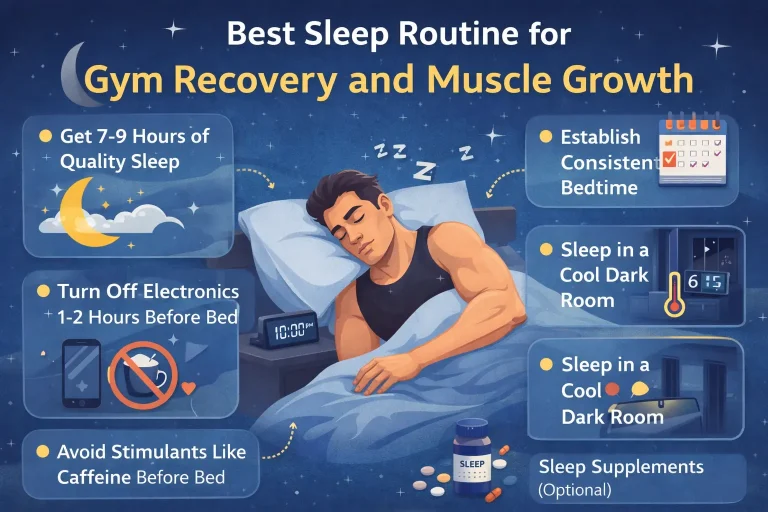
Sleep: Non-Negotiable Recovery Tool
Most gym-goers prioritize everything except sleep. Then they wonder why progress stalls.
Sleep quality directly impacts:
- Testosterone and growth hormone production – Both peak during deep sleep
- Muscle protein synthesis – Your body literally builds muscle while sleeping
- CNS recovery – Your nervous system recovers from intense training
- Recovery hormone balance – Cortisol (catabolic) decreases during sleep
Sleep protocol for muscle building:
- 7-9 hours nightly (most people need this)
- Consistent sleep schedule (same bedtime/wake time)
- Cool, dark bedroom (60-67°F is ideal)
- No screens 30-60 minutes before bed
- Avoid caffeine after 2 PM
If you’re training hard but sleeping 5-6 hours, you’re handicapping yourself. Your genetics, supplements, or diet won’t overcome poor sleep.
Active Recovery: The Secret Weapon
Active recovery doesn’t mean sitting on the couch. It means engaging in light activity on non-training days:
- Walking 30-60 minutes (most underrated recovery tool)
- Swimming or cycling at easy pace
- Yoga or stretching
- Light resistance training with 40% effort
Active recovery promotes blood flow, clears metabolic byproducts, and speeds up actual recovery without impeding the next training session. Most natural builders improve dramatically by adding 2-3 easy days weekly.
Stress Management and Cortisol
Chronic stress elevates cortisol, which suppresses testosterone and impairs muscle growth. It also triggers poor sleep and food cravings.
Practical stress management:
- Meditation: Even 10 minutes daily
- Walking in nature
- Hobby time unrelated to fitness
- Limiting social media consumption
- Addressing sleep debt first
Micronutrients and Whole-Food Nutrition
Your body needs vitamins and minerals for every metabolic process. While you don’t need supplement powders, you do need whole foods rich in micronutrients.
Prioritize:
- Leafy greens: Iron, magnesium, folate
- Berries: Antioxidants for recovery
- Nuts and seeds: Magnesium, zinc, selenium
- Sweet potatoes: Vitamins, minerals, carbs
- Salmon: Omega-3s, vitamin D, selenium
These foods contain hundreds of bioactive compounds that supplements simply can’t replicate.
Deload Weeks: Strategic Recovery
Every 4-8 weeks, take a “deload week” where you reduce training volume by 40-50%. Instead of 4 sets of squats, do 2. Instead of 10 exercises, do 5.
This allows accumulated fatigue to dissipate, prevents overuse injuries, and actually enhances long-term gains. Many natural builders see better performance returns after a deload despite “doing less.”
Building Your Natural Muscle Plan: From Beginner to Advanced
Muscle-building timelines depend on training age, genetics, and consistency, but here’s a realistic roadmap.
Beginner Phase (First 0-3 Months)
You’ll make the fastest progress here. Beginner gains are real because your nervous system is learning movement patterns and becoming more efficient.
Realistic expectations:
- 3-5 pounds of muscle gain (maybe more if you’re truly untrained)
- 5-10% body fat increase
- Noticeable strength increases (30-50% on major lifts)
- Visible arm, shoulder, and chest development
Strategy:
- Focus on form and consistency, not heavy weight
- 3-4 training days weekly
- Stick to simple programs (upper/lower split or full-body 3x weekly)
- Gain 0.5-1 pound weekly
Intermediate Phase (Months 3-12)
Progress slows. You’ve built nervous system efficiency and you’re tapping out beginner gains.
Realistic expectations:
- 8-12 pounds of muscle in this 9-month period (not monthly)
- Development of muscle definition as you gain more muscle relative to fat
- Visible changes in body composition
- Strength gains on major lifts of 20-30%
Strategy:
- Increase training frequency if doing full-body (4-5 days weekly)
- Implement periodization (vary rep ranges monthly)
- Add variety in exercise selection
- Fine-tune nutrition based on results
Advanced Phase (Year 2+)
You’re now experienced. Progress is slower but achievable with smart training.
Realistic expectations:
- 4-6 pounds of muscle yearly at this phase
- More selective body composition changes
- Minimal body fat gain if surplus is modest
- Mostly strength maintenance with slight increases
Strategy:
- Highly individualized programming
- Advanced periodization techniques
- Plateau-busting strategies
- Possible consideration of specialization phases
Expert Tips & Advanced Strategies
Once you’ve mastered the basics, these strategies help break plateaus and optimize your gains.
Periodization: Varying Your Training
Periodization means varying your training variables (weight, reps, rest periods) systematically.
Simple periodization protocol:
Week 1-2: Strength Phase
- 5-6 reps per set
- Heavy weight
- 3-minute rest
- Focus: Mechanical tension
Week 3-4: Hypertrophy Phase
- 8-12 reps per set
- Moderate weight
- 90-second rest
- Focus: Time under tension
Week 5-6: Endurance Phase
- 12-15 reps per set
- Light weight
- 60-second rest
- Focus: Metabolic stress
Week 7: Deload
- 40% volume reduction
- Recovery focus
This provides varied stimulus, prevents adaptation, and actually feels novel. Your muscles don’t know you’re doing “different reps”—they know they’re stressed differently, which drives growth.
Mind-Muscle Connection
The stronger your neural connection to a muscle, the more effectively you recruit its fibers. Higher recruitment = more potential growth.
Techniques:
- Slow, controlled reps (2 seconds up, 1 second down, 2 seconds up)
- Pausing at peak contraction
- Focusing intently on the working muscle
- Higher reps on isolation exercises (12-15 reps) increase mind-muscle connection
This isn’t mystical. Research shows better mind-muscle connection correlates with greater hypertrophy, particularly on isolation movements.
RIR: Reps in Reserve
RPE (Rate of Perceived Exertion) is useful, but RIR (Reps in Reserve) is more practical.
If you do 8 reps and could do 10 before failure, you have 2 RIR. For optimal natural muscle building:
- Compound exercises: 2-3 RIR
- Isolation exercises: 0-2 RIR
This balances growth stimulus with recovery. Beginners often go to failure on every set, creating excessive recovery demand. Experienced lifters know that leaving 2-3 reps in reserve allows more volume with better recovery.
Common Mistakes That Sabotage Natural Muscle Building
Mistake #1: Doing Too Much Too Soon
Beginners often follow advanced training splits with 20+ sets per muscle group, then wonder why they’re burnt out and not recovering.
Fix: Start with 10-15 sets per muscle group weekly. You’ll make excellent progress and feel recovered. As you adapt over months, gradually increase.
Mistake #2: Inconsistent Training
Missing sessions, skipping weeks, or training on random schedules prevents adaptation. Your body adapts to consistent stimulus.
Fix: Schedule training like appointments. Aim for 90% adherence annually (missing only 5-6 sessions). Consistency compounds.
Mistake #3: Under-Eating Despite Heavy Training
You can’t gain muscle in a caloric deficit. Yet many people train hard while eating “clean” in a deficit and wonder why they don’t build muscle.
Fix: If you want to build muscle, you need a surplus. Accept some fat gain. You’ll look better 6 months with 12 pounds of muscle + 4 pounds of fat than staying lean while spinning wheels.
Mistake #4: Neglecting Sleep and Recovery
Training hard without recovery is like saving money without a bank account.
Fix: Make sleep non-negotiable. Before optimizing anything else, establish 7-9 hour sleep as your baseline.
Mistake #5: Following Influencer Routines That Don’t Fit
That 25-year-old fitness influencer promoting a 20-set-per-muscle routine is either supplementing, genetically gifted, or both. Your 40-year-old body needs different stimulus.
Fix: Follow evidence-based programs designed for your training age and recovery capacity. Adjust as needed.
Building Muscle Naturally: What to Actually Expect
Let’s be honest about timelines. Too many people expect unrealistic results and quit when reality doesn’t match fantasies.
First 3 Months
What you’ll see:
- Strength increases of 30-50% on major lifts
- Noticeable development in arms and shoulders
- Pants fitting differently around the glutes and quads
- Others noticing changes
What you won’t see:
- Magazine-cover-worthy physique
- Dramatic body composition change
- Advanced muscle definition
This is the “motivational phase” where discipline feels rewarding and progress is obvious.
First Year
What you’ll see:
- 15-25 pounds of muscle gain (mixed with some fat)
- Visible muscle definition
- Significant strength increases
- Genuine body composition transformation
- People asking “Are you working out?”
What you won’t see:
- Pro-level physique (that takes 3-5 years minimum)
- The ability to maintain 8% body fat while gaining muscle (natural trade-offs exist)
Year one is where most people make the decision: “This is worth it” or “This is too much work.” Those who continue typically see remarkable results.
2-3 Year Perspective
What you’ll see:
- 35-50 pounds of muscle gain from baseline (depending on starting point)
- Significant strength gains
- Potentially impressive physique without drugs
- Complete lifestyle transformation
- Others regularly asking for training advice
This is where consistency truly compounds.
FAQ: Your Top Muscle-Building Questions Answered
Q: How much muscle can I realistically build without supplements?
A: As much as anyone with supplements. Supplements don’t create muscle—training, nutrition, and recovery do. A natural lifter with perfect execution will build as much muscle as someone supplementing with poor execution. The reality: supplements can provide marginal gains for advanced lifters, maybe 5-10% optimization. But the basics are non-negotiable for everyone.
Q: Do I need to meal prep?
A: Not necessarily. You need to hit calories and macros consistently. Some people do this with meal prep; others eat simple meals repeatedly. Choose the method you’ll actually follow. If meal prep feels like torture, you won’t sustain it.
Q: Can I build muscle while losing fat simultaneously?
A: Beginners can do this. It’s called “body recomposition.” Advanced lifters? Much harder because you need a surplus for optimal muscle building and a deficit for fat loss. Most experienced lifters choose to bulk (build muscle, accept some fat) then cut (lose fat while preserving muscle) cyclically.
Q: What’s the minimum training frequency for muscle growth?
A: Hit each muscle group twice weekly. More is fine; less is suboptimal. Once weekly doesn’t provide sufficient stimulus for natural lifters.
Q: Do I need to count calories exactly?
A: No, but you need to track consistently for 2-3 weeks to understand where you are. Then you can estimate, adjusting based on weight trends. If you’re not gaining 0.5-1 pound weekly in a bulk, eat more.
Q: How important is supplementing with vitamins?
A: If you eat diverse whole foods (vegetables, fruits, nuts, meats), you’ll get most micronutrients naturally. A basic multivitamin or vitamin D supplement (especially if you’re in a dark climate) is reasonable, but not essential if your diet is solid.
Q: Can I build muscle training at home without a gym?
A: Yes. Progressive overload works with bodyweight too. Progressively increase reps, decrease rest, improve form, or increase difficulty (pistol squats vs. regular squats). Many bodyweight progressions exist. You’ll eventually hit a ceiling without weights, but it’s higher than most assume.
Q: What’s the best protein powder if I want to supplement?
A: If you choose to supplement protein powder, whey protein is effective, cost-efficient, and well-researched. One scoop (25g protein) is cheaper and more convenient than eating 4 egg whites. But it’s not necessary—whole foods work fine.
Q: How do I know if I’m eating enough to build muscle?
A: Track weight weekly. In a proper surplus with good training, you’ll gain 0.5-1 pound weekly. If you’re not gaining, eat more. If you’re gaining more than 1.5 pounds weekly, you’re probably overeating (excess fat gain with muscle).
Q: Do genetics determine how much muscle I can build?
A: Genetics influence your ceiling and rate of progress. But most people never reach 50% of their natural potential before deciding genetics limit them. Bad genetics might mean slower progress, but consistent training, eating, and sleeping for 3-5 years will produce impressive results regardless.
Conclusion:
Building muscle naturally is straightforward. Not easy—straightforward.
You need progressive training that challenges your muscles consistently. You need adequate calories and protein to support growth. And you need sleep and recovery to let adaptation happen.
That’s it.
No supplements. No genetic predisposition requirement. No fancy equipment or secret routines.
What separates people who build muscle from people who spin wheels is consistency, patience, and humility—the willingness to trust the process when progress feels slow.
The men and women I’ve watched transform most dramatically weren’t the smartest about fitness. They weren’t the genetically gifted. They were simply the ones who showed up, did boring exercises with progressively heavier weight, ate good food consistently, and slept.
In six months, nobody will notice. In a year, everyone will. In three years, people will ask if you’re on steroids.
You’re closer to an impressive physique than you think. You’re just one year of consistency away from turning heads.
Start this week. Not next Monday. Not after your vacation. Now. Because a year from now, you’ll wish you’d started today.
8. KEY TAKEAWAYS
- Progressive overload is non-negotiable – You must gradually increase training demands for muscles to adapt and grow
- Supplements are optional, fundamentals are mandatory – Training, nutrition, and recovery matter infinitely more than supplements
- Eat in a surplus – You cannot build muscle efficiently in a caloric deficit; 300-500 calories above maintenance is ideal
- Consume adequate protein – 0.7-1g per pound of bodyweight supports muscle protein synthesis
- Sleep is underrated – 7-9 hours directly impacts testosterone, growth hormone, and muscle growth
- Consistency beats perfection – 80% consistency over 12 months beats perfect execution for 3 months
- Expect realistic timelines – First year: 15-25 lbs muscle gain; subsequent years: 4-6 lbs annually
- Focus on compound movements – Squats, deadlifts, bench press, and rows deliver the most muscle-building stimulus
- Train each muscle group twice weekly – Once isn’t sufficient stimulus for natural muscle growth
- Recovery is where growth happens – Muscles grow during rest, not during the workout.