
What Time Should You Actually Go to Sleep Tonight?
Step 1: The Introduction (Hook — No Definitions, No Fluff)
You have a 6:30 AM alarm set. It is 10:45 PM. You are lying in bed scrolling, not because you are not tired, but because you genuinely do not know if now is the right time to sleep or if staying up another hour will somehow make tomorrow better.
It will not. But you already knew that.
What you probably did not know is that the time you fall asleep matters almost as much as how long you sleep. Go to bed at the wrong hour and you can wake up after a full eight hours feeling worse than if you had slept six. That is not bad luck. That is biology.
This guide walks you through exactly how to find your personal ideal bedtime — not a generic number from a health chart, but the actual time that works for your alarm, your age, and how your body is wired.
Use the Sleep Calculator at sleepingtime.online alongside this guide if you want the numbers done for you instantly.
Step 2: Why “Just Sleep 8 Hours” Is Incomplete Advice
You have heard the eight-hour rule your entire life. Sleep eight hours. Wake up refreshed. Simple.
Except it is not that simple, and most people find that out the hard way.
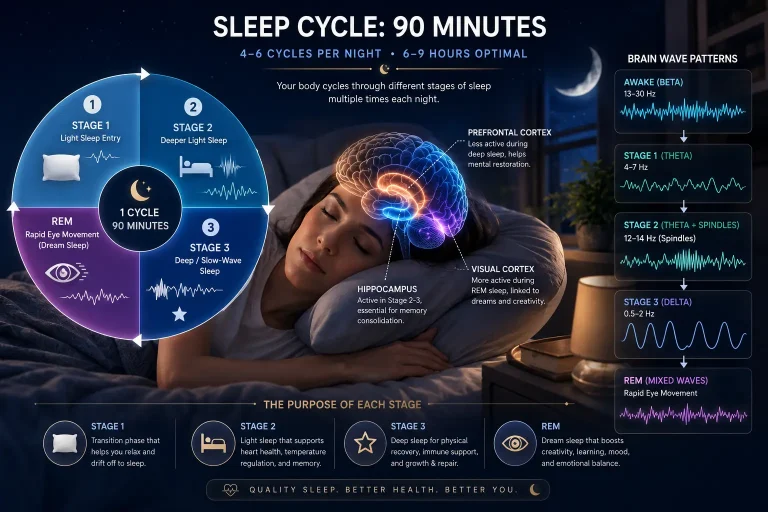
Here is what the eight-hour rule leaves out: your body does not sleep in one long continuous block. It cycles through stages roughly every 90 minutes — light sleep, deep sleep, and REM sleep. Each full cycle takes you through all three. By the time morning arrives, you have completed somewhere between four and six of these cycles depending on when you fell asleep.
The problem happens when your alarm cuts a cycle in half.
Imagine your sleep as a washing machine. Each cycle has to finish before the drum stops. If you open the door mid-cycle, you get wet laundry. Waking up mid-sleep-cycle feels the same — groggy, foggy, and irritable for the first hour of your day even if you technically slept enough hours.
This is why two people can both sleep exactly eight hours and one wakes up feeling sharp while the other feels wrecked. The difference is almost always timing — specifically, whether they woke at the end of a cycle or in the middle of one.

Step 3: The 90-Minute Rule — How to Calculate Your Bedtime
Here is the calculation that changes everything.
Start with your wake-up time. Count backwards in 90-minute blocks. Each block is one complete sleep cycle. Most adults feel best after five or six complete cycles, which is 7.5 to 9 hours of sleep.
Add 15 minutes on top of that for the time it takes most people to actually fall asleep after lying down.
The formula:
Wake-up time → subtract 7.5 hours (5 cycles) or 9 hours (6 cycles) → subtract 15 more minutes for sleep onset → that is your target bedtime.
Bedtime Chart: Find Your Ideal Sleep Time by Wake-Up Hour
| Wake-Up Time | 5 Cycles (7.5 hrs) | 6 Cycles (9 hrs) |
|---|---|---|
| 5:00 AM | 9:15 PM | 7:45 PM |
| 5:30 AM | 9:45 PM | 8:15 PM |
| 6:00 AM | 10:15 PM | 8:45 PM |
| 6:30 AM | 10:45 PM | 9:15 PM |
| 7:00 AM | 11:15 PM | 9:45 PM |
| 7:30 AM | 11:45 PM | 10:15 PM |
| 8:00 AM | 12:15 AM | 10:45 PM |
| 8:30 AM | 12:45 AM | 11:15 PM |
| 9:00 AM | 1:15 AM | 11:45 PM |
How to use this table: Find your alarm time in the left column. The two columns to the right show your two best bedtime options. If you can only get five cycles tonight, that is still better than lying awake trying to force six.
Most adults land best at five cycles — 7.5 hours. Six cycles is ideal if you are recovering from illness, a heavy training week, or a run of short nights.
Step 4: The Best Bedtime Range for Most Adults
Research published in the European Heart Journal looked at the sleep timing of over 88,000 adults and found something specific: people who fell asleep between 10:00 PM and 11:00 PM had the lowest rates of cardiovascular problems compared to those who went to bed earlier or significantly later.
That does not mean 10:30 PM is magic for everyone. What it means is that this window tends to align with the body’s natural melatonin rise for most adults — the point where your brain is actively preparing for sleep. Fighting that window by staying awake past it burns through melatonin and makes falling asleep harder even when you are exhausted.
Think of melatonin like a wave. It builds slowly through the evening and peaks around 10:00 to 11:00 PM for the average adult. Catch the wave and sleep comes easily. Miss it and you are waiting for the next one, which might not arrive for another hour or two.
The practical takeaway: if your schedule allows it, a bedtime somewhere between 10:00 PM and 11:00 PM, timed to your specific wake hour using the chart above, is the target zone for most adults.
Step 5: Your Chronotype Changes Your Ideal Bedtime
Here is where the generic sleep advice breaks down.
Not everyone’s melatonin wave arrives at 10:00 PM. For roughly 20 to 25 percent of people — the ones who are naturally wired to stay awake later — that wave does not come until midnight or 1:00 AM. These people are not lazy or undisciplined. They have a genetic difference in how their internal clock is set.
Sleep researchers call this your chronotype — essentially, whether your body clock runs early, average, or late. You might know it by simpler labels: morning person or night owl.
Here is what that means for your bedtime:
If you are a natural early riser (morning type): Your ideal bedtime is probably between 9:00 PM and 10:30 PM. Staying up past 11:00 PM feels genuinely unpleasant for you because your melatonin has already peaked and is declining.
If you fall somewhere in the middle (most people): The 10:00 PM to 11:30 PM window is your natural zone. This is where the standard sleep advice works reasonably well.
If you are a natural night owl (evening type): Your body is not ready for sleep until 11:30 PM to 1:00 AM. Forcing yourself to bed at 10:00 PM will not make you fall asleep faster — it will mostly just make you lie there frustrated.
The challenge is that most jobs and schools operate on early-type schedules, which forces night owls into a permanent state of misalignment. If this is you, morning light therapy — sitting near a bright light within 30 minutes of waking — is the most effective tool for gradually shifting your body clock earlier.
Step 6: Does Your Bedtime Change with Age?
Yes, and more than most people realize.
Children need significantly more sleep and naturally trend toward earlier bedtimes. A seven-year-old’s body clock is often ready for sleep by 7:30 to 8:30 PM.
Teenagers are the most misunderstood group here. There is a well-documented biological shift during puberty that pushes the adolescent clock two to three hours later. A 15-year-old who cannot fall asleep before midnight is not choosing to stay up — their melatonin literally does not rise until late evening. This is why early school start times cause significant sleep deprivation in teenagers across the board.
Adults in their 20s and 30s typically operate on the standard 10:00 PM to 11:00 PM range, though evening types remain evening types throughout adulthood.
From the mid-40s onward, the clock tends to shift gradually earlier. Many adults in their 50s and 60s find themselves genuinely tired by 9:00 PM, which is a biological shift, not a sign of getting old before their time.
| Age Group | Natural Bedtime Range |
|---|---|
| Children (6–12 years) | 7:30 PM – 9:00 PM |
| Teenagers (13–18 years) | 11:00 PM – 1:00 AM (biological tendency) |
| Young adults (18–30 years) | 10:30 PM – 12:00 AM |
| Adults (30–50 years) | 10:00 PM – 11:30 PM |
| Older adults (50+) | 9:00 PM – 10:30 PM |
Step 7: Three Common Bedtime Mistakes (And Exactly How to Fix Them)
Mistake 1: Going to bed at the same time regardless of your wake-up hour
Most people pick a bedtime based on habit — “I always go to bed at 11” — without working backwards from when they actually need to wake up. On days when you have a 5:30 AM alarm, 11:00 PM might mean only four and a half hours of sleep. The fix is simple: make your bedtime a function of your wake time, not a fixed number. Use the chart in Step 3 every week when your schedule changes.
Mistake 2: Lying in bed awake for an hour before actually falling asleep
If you get into bed at 10:30 PM but spend an hour scrolling or staring at the ceiling, your actual sleep onset is 11:30 PM — which means the bedtime chart is off by a full hour. The solution is to get into bed only when you feel genuinely sleepy, not just tired. There is a difference. Tired means your body is fatigued. Sleepy means your eyes are heavy and your brain is slowing down. Only the second one means your body is actually ready to sleep.
Mistake 3: Different bedtimes on weekdays and weekends
This is probably the most common sleep mistake in modern life. You go to bed at 10:30 PM on weeknights but stay up until 1:00 or 2:00 AM on Friday and Saturday. Then you sleep in until 10:00 AM to compensate. By Sunday night, your body clock has shifted two to three hours later — which is why Monday mornings feel like jetlag. Researchers actually call this social jetlag and it is associated with real metabolic and cognitive consequences. The fix is uncomfortable but effective: keep your wake time within one hour of your weekday time, even on weekends. You can go to bed a little later on weekends. But the wake time is what anchors your clock.
Step 8: Your Action Plan for Tonight
You do not need to overhaul your entire sleep routine to start sleeping better. You need two numbers: your wake time and your bedtime.
Here is what to do right now:
Decide what time you need to wake up tomorrow. Look at the chart in Step 3. Find your wake-up time and pick the bedtime that gives you five complete cycles. Set a phone reminder for 20 minutes before that bedtime — not to go to sleep, but to start winding down. Dim your lights, put your phone face down, and give your brain the signal that the day is ending.
Do that for seven days without changing your wake time. Even on the weekend, stay within 45 minutes of it.
After one week, check how you feel in the first 30 minutes of waking. That window is the most honest signal of whether your sleep timing is working. If you are waking up before your alarm and feeling okay, your timing is right. If you are hitting snooze four times and still foggy at 9 AM, you either need to move your bedtime earlier by 90 minutes or investigate whether something else is disrupting your sleep quality.
For the fast version of all this, the Sleep Calculator at sleepingtime.online does the full 90-minute cycle math for you based on whatever time you enter. It takes about ten seconds and gives you every optimal bedtime option for your specific wake hour.
Conclusion
The right bedtime is not the same for everyone, and it is not even the same for you every night. It changes with your schedule, your age, your chronotype, and what your body is recovering from.
But the underlying logic is always the same. Work backwards from your alarm. Aim for five or six complete 90-minute cycles. Try to catch your melatonin window. Keep your wake time consistent.
Do those four things and the grogginess, the mid-afternoon fog, and the lying-awake-at-midnight problem start to solve themselves — not because you did something dramatic, but because you finally gave your body the timing it was asking for.
![Understanding Calorie Deficit for Sustainable Weight Loss [Science-Based]](https://sleepingtime.online/wp-content/uploads/2026/06/Calorie-Deficit-for-Sustainable-Weight-Loss-768x512.webp)