Stress Management Techniques Backed by Science: 11 Evidence-Based Methods
What is Stress Management?
Stress management is the practice of using specific techniques and strategies to reduce your body's stress response and build resilience to handle pressure more effectively.
You’re probably better at managing your work than managing your stress about the work.
It’s the irony of professional life. You’ve built systems for everything else—project management, email workflows, client relationships. But stress? That just happens to you. You white-knuckle through it, hoping it goes away, knowing it won’t.
The problem isn’t that stress management techniques don’t work. They do. The problem is that most advice floats somewhere between “too vague to implement” and “requires a lifestyle change you can’t actually make.”
This article is different. You’re getting 11 specific stress management techniques backed by neuroscience and behavioral research, with implementation guidance that actually fits into a busy professional’s life. Not theoretical. Not idealistic. Practical.
Understanding Stress: The Physiological Basis
Before you can effectively manage stress, you need to understand what you’re actually managing.
Stress isn’t an emotional problem. It’s a biological response—one that’s incredibly useful in acute situations but becomes destructive when activated chronically.
Here’s how it works:
Your brain perceives a threat (real or imagined). Your amygdala triggers your hypothalamic-pituitary-adrenal axis (HPA axis). Within seconds, your body releases cortisol and adrenaline. Your heart rate increases, your blood vessels constrict, your immune system temporarily suppresses, your digestive system pauses, and your prefrontal cortex (the logical decision-making part) goes partially offline. Instead, you shift to your limbic system (the emotional, survival-focused part).
This is fantastic if you’re facing an actual threat. It’s terrible if you’re responding to a critical email from your boss.
The problem is that your body doesn’t distinguish between a saber-toothed tiger and a deadline. Both trigger the same response. And while that tiger disappears after a few seconds, your work deadlines don’t. So your stress response never fully deactivates.
Acute stress (short-term, specific threat) actually improves performance. Your body floods with cortisol and adrenaline, sharpening focus and response time.
Chronic stress (prolonged, persistent activation of the stress response) is what damages you. Your body remains in a state of partial activation. Cortisol stays elevated. Your immune system stays suppressed. Inflammation increases. Your cardiovascular system stays taxed. Your digestive system stays sluggish. And your prefrontal cortex stays diminished, making rational decision-making harder precisely when you need it most.
This isn’t weakness. This is physiology. Understanding this distinction is crucial because it means stress management isn’t about being “tougher” or “more resilient” in some abstract way. It’s about actively downregulating your nervous system so your body can operate normally again.
The Cost of Unmanaged Stress: Why This Actually Matters
You already know stress feels bad. But understanding what chronic stress actually costs you—in concrete, measurable ways—creates urgency to actually implement solutions.
Cardiovascular impact: Chronic stress increases blood pressure, increases inflammation in your arteries, increases your risk of atherosclerosis, and increases your risk of heart attack and stroke. The American Heart Association identifies chronic stress as a genuine cardiovascular risk factor comparable to smoking or high cholesterol.
Metabolic disruption: Chronically elevated cortisol promotes fat storage (particularly abdominal fat), increases insulin resistance, and increases blood sugar irregularity. It actively works against maintaining healthy body composition, regardless of diet and exercise.
Immune suppression: Your immune system downregulates under chronic stress. You get sick more frequently, recover more slowly, and are more susceptible to infections. You’re literally more vulnerable to illness.
Cognitive degradation: Chronic stress impairs executive function, reduces working memory, decreases your ability to focus, and compromises decision-making. The part of your brain that makes strategic decisions is literally less active during chronic stress, yet that’s precisely when you need it most.
Sleep disruption: Cortisol should be high in the morning and decline throughout the day. Chronic stress flattens this pattern. You struggle to fall asleep (racing thoughts), experience fragmented sleep, and wake unrefreshed. Poor sleep then perpetuates stress, creating a vicious cycle.
Emotional dysregulation: Chronic stress makes you irritable, reactive, anxious, and depressed. Your emotional resilience decreases. Small annoyances feel catastrophic. Your patience disappears.
Professional impact: Stress reduces productivity, impairs decision-making, damages relationships with colleagues, increases likelihood of burnout, and ultimately limits career progression. The irony is that the stress you’re experiencing “in service of your career” is actively harming your career performance.
The research is unambiguous: chronic stress costs you money, health, relationships, and performance. Managing it isn’t self-care. It’s performance optimization.

11 Evidence-Based Methods Professionals Actually Use
Technique 1: Controlled Breathing (Immediate, 2-10 minutes)
Your breathing is the only bodily system that’s both automatic and voluntary. You don’t have to think about breathing, but you can intentionally change how you breathe. This makes breathing a direct line to your nervous system.
When you’re stressed, your breathing becomes shallow and rapid (chest breathing). This actually perpetuates the stress response because your nervous system interprets shallow breathing as “still in danger.”
Controlled breathing does the opposite. Slow, deep breathing signals to your nervous system that the threat has passed. Your body downregulates.
Box Breathing Protocol (most effective for acute stress):
- Inhale for 4 counts
- Hold for 4 counts
- Exhale for 4 counts
- Hold for 4 counts
- Repeat for 2-5 minutes
This takes literally 2 minutes and produces measurable nervous system changes. You can do it at your desk, in a meeting, or in your car.
4-7-8 Breathing (best for evening stress/sleep preparation):
- Inhale for 4 counts
- Hold for 7 counts
- Exhale for 8 counts
- Repeat 4 times
The extended exhale activates your parasympathetic nervous system (your “rest and digest” system). Do this before bed or when you need deeper relaxation.
Timeline: Effects are immediate. Your heart rate and blood pressure begin declining within 1-2 minutes. This is one of the fastest stress management techniques available.
Technique 2: Progressive Muscle Relaxation (10-20 minutes)
Your body holds stress as physical tension. You tighten your shoulders, clench your jaw, and tense your core without consciously realizing it. This muscular tension reinforces your stress response—your nervous system interprets tense muscles as “still in danger.”
Progressive muscle relaxation breaks this cycle by intentionally tensing and then releasing muscle groups, teaching your body what relaxation actually feels like.
Protocol:
- Start with your feet. Tense the muscles for 5 seconds, then release and notice the difference for 30 seconds.
- Move to your calves, then thighs, glutes, core, chest, arms, hands, shoulders, neck, and face.
- Work methodically through your entire body.
Duration: 15-20 minutes the first time you do it. As you practice, you can do abbreviated versions (2-3 minutes) focusing only on areas holding tension.
Timing: Best done in the evening or before bed. It combines well with controlled breathing.
Research basis: Studies in Behavior Research and Therapy demonstrate that progressive muscle relaxation produces measurable reductions in cortisol, blood pressure, and self-reported anxiety. It’s particularly effective for people who hold stress as physical tension.
Technique 3: Strategic Physical Activity (20-60 minutes, 3-5x per week)
Exercise is one of the most powerful stress management tools available. It’s not about fitness or aesthetics—it’s about neurotransmitter regulation.
When you exercise, your body releases endorphins, increases dopamine and serotonin production, and downregulates cortisol. You literally change your brain chemistry. The stress doesn’t go away; your capacity to handle stress increases.
Which types work best for stress?
Aerobic activity (moderate intensity, 20-40 minutes): Running, cycling, swimming, or rowing at a pace where you can talk but not sing. This intensity produces the strongest endorphin and mood-elevation effects.
Strength training (30-45 minutes): Lifting weights produces a sense of control and mastery, which directly counteracts the helplessness stress creates. Plus, the focus required during training forces your mind away from stressors.
Mind-body practices (yoga, tai chi): These combine physical activity with breathing and mindfulness, creating a more comprehensive stress-reduction effect.
Timing: Within 4-6 hours of your most stressful time is ideal. Morning exercise sets a positive neurochemical tone for the day. Afternoon/evening exercise processes accumulated stress.
Duration: Research shows meaningful benefits begin around 20 minutes. The sweet spot is 30-60 minutes. More than 90 minutes of intense exercise can actually increase cortisol, so more isn’t always better.
Timeline: You’ll notice improved mood within one session. Stress resilience improvements emerge over 2-4 weeks of consistent practice.
Technique 4: Cognitive Reframing (5-15 minutes, as needed)
Your thoughts amplify stress. Your brain doesn’t distinguish between real threats and imagined threats. You catastrophize (“This email is critical—I’m definitely getting fired”), and your body responds with the same stress response as if the catastrophe were already happening.
Cognitive reframing interrupts this cycle by deliberately changing how you interpret a situation.
Three Reframing Approaches:
1. Challenge the thought: Is this thought actually true? You didn’t get the promotion. That’s a fact. But the thought “I’m a failure and will never advance” isn’t a fact—it’s a projection. Separate facts from interpretations.
2. Look for alternative interpretations: Your presentation didn’t go perfectly. Interpretation A: “I bombed and everyone thinks I’m incompetent.” Interpretation B: “The presentation had rough moments and a few things I’d do differently next time. People didn’t notice most of the mistakes I noticed.” Which is more likely accurate?
3. Zoom out in time: In five years, will this matter? Not “will you still be upset,” but objectively—will this event significantly impact your life trajectory? Most work stressors won’t. This perspective reduces their current power over you.
Professional implementation: Keep a “thought log” for one week. Write down thoughts that triggered stress. Then write down a realistic, alternative interpretation. Over time, your brain begins automatically generating more balanced thoughts.
Technique 5: Mindfulness and Meditation (5-20 minutes daily)
Meditation is one of the most researched stress management techniques. Functional MRI studies show that regular meditation changes your brain structure, particularly in areas related to emotional regulation and stress response.
Important clarification: You don’t need to be “good at” meditation for it to work. The goal isn’t to have a blank mind (that’s actually impossible). The goal is to notice your mind wandering and gently bring it back. That noticing-and-redirecting is what rewires your brain.
Beginner Protocol (skeptics often prefer this):
- Sit comfortably for 5 minutes
- Focus on your breath (the sensation of air entering your nostrils)
- When your mind wanders (it will), notice it without judgment
- Bring your attention back to your breath
- Repeat for 5 minutes
That’s it. Five minutes of this daily for two weeks produces measurable changes in stress markers.
Why this works: Meditation trains your brain to observe thoughts without reacting to them. You notice the anxious thought arise, but instead of being pulled into it, you watch it and return to your breath. Over time, you become less identified with stressful thoughts. They’re just thoughts, not reality.
Timeline: You’ll notice slight calming effects after the first session. Meaningful changes in stress resilience emerge around 4 weeks of consistent practice.
Alternative: If sitting meditation feels uncomfortable, walking meditation (focusing on the sensation of each step) or body scan meditation (progressively noticing sensations throughout your body) are equally effective.
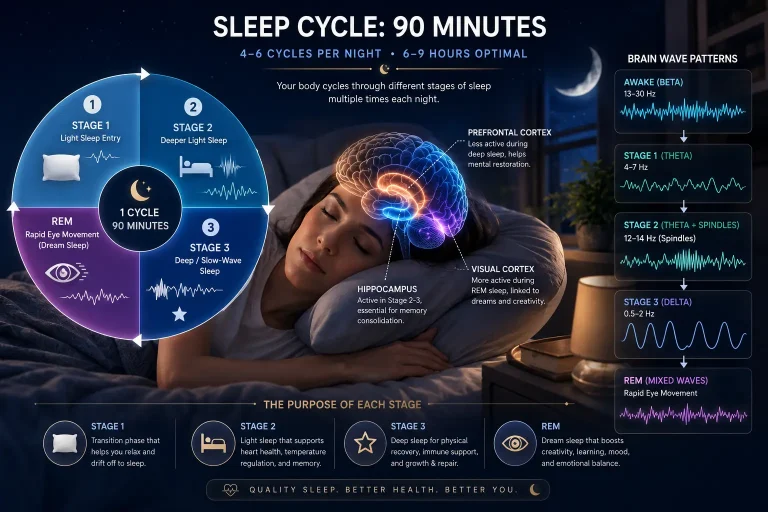
Technique 6: Sleep Optimization (7-9 hours nightly)
Sleep deprivation increases cortisol, impairs stress resilience, and reduces your capacity to handle stress. Conversely, optimized sleep is one of the most powerful stress management tools available.
The reciprocal relationship is important: poor sleep increases stress, and stress impairs sleep. Breaking this cycle requires prioritizing sleep as seriously as you’d prioritize any important work project.
Immediate sleep improvements:
- Consistent sleep schedule (same bedtime/wake time, even weekends)
- Cool bedroom (65-68°F)
- Dark bedroom (blackout curtains)
- No screens 60 minutes before bed
- No caffeine after 2 PM
Timeline: Sleep quality improves within 3-7 days. Stress resilience improvements emerge around 2 weeks of consistent sleep.
Technique 7: Social Connection (Regular, ongoing)
Loneliness and social isolation increase stress. Conversely, meaningful social connection reduces cortisol, increases oxytocin (your “bonding” hormone), and improves stress resilience.
This doesn’t mean you need to be highly social. It means meaningful connection with even one person significantly buffers stress.
Strategic implementation:
- Schedule specific time with people you genuinely enjoy
- Have conversations beyond surface-level chat
- Vulnerability (appropriate sharing of struggles) deepens connection and reduces stress burden
- Quality matters far more than quantity
Professional context: Colleagues can serve this function. People who report feeling connected to their team experience significantly less work stress than those who feel isolated, even in identical roles.
Technique 8: Boundary Setting (Implementation varies, 1-4 weeks)
Many professionals experience stress because they’re attempting infinite responsiveness in a finite time. Boundaries solve this.
Specific boundary-setting strategies:
Time boundaries: Establish work start/end times and largely stick to them. If you work until 11 PM daily, stress never fully resolves because your nervous system never fully downregulates.
Communication boundaries: Set expectations about response times. “I respond to emails daily at 9 AM and 3 PM” is healthier than constant email reactivity.
Meeting boundaries: “I don’t schedule back-to-back meetings” or “I decline meetings without clear agenda.” This creates space in your day and reduces decision fatigue.
Task boundaries: You cannot do everything. Explicitly deciding what you won’t do (in any given day, week, or quarter) is crucial.
Guilt management: Boundaries feel selfish initially because you’ve been operating without them. You feel guilty. That’s the feeling that needs reframing. Setting boundaries isn’t selfish—it’s necessary for sustainable performance.
Timeline: Boundaries feel awkward for 1-4 weeks. Then they become normal and stress visibly decreases.
Technique 9: Nutritional Stress Management
Your diet directly affects your stress response and stress resilience.
Key nutrients and foods:
Omega-3 fatty acids (fish, flaxseed, walnuts): Reduce inflammation and support brain health. People with adequate omega-3s show lower baseline cortisol.
Complex carbohydrates (whole grains, legumes, vegetables): Increase serotonin production. They have a mood-stabilizing effect, particularly beneficial when stressed.
Magnesium (leafy greens, nuts, seeds, dark chocolate): Supports nervous system regulation. Magnesium deficiency is associated with increased anxiety and stress.
B vitamins (whole grains, eggs, almonds): Support stress hormone metabolism. B deficiency impairs your body’s ability to process stress.
Protein (consistent across meals): Stabilizes blood sugar and provides amino acids for neurotransmitter production.
What to minimize:
- Excessive caffeine (amplifies anxiety and stress)
- Refined carbohydrates (blood sugar spikes and crashes amplify stress)
- Alcohol (interferes with sleep and nervous system regulation)
Implementation: You don’t need to overhaul your diet. Adding one serving of vegetables daily, one source of omega-3s weekly, and one magnesium-rich food daily produces noticeable improvements.
Technique 10: Vagus Nerve Activation
Your vagus nerve is the primary component of your parasympathetic nervous system (your “rest and digest” system). Stimulating it directly activates your stress-recovery system.
Vagus nerve activation techniques:
Cold water exposure: Splash cold water on your face or hold an ice cube in your mouth for 30 seconds. The cold water trigger activates the vagus nerve, producing an immediate calming effect.
Humming or singing: The vibration from vocalization stimulates the vagus nerve. Even 30 seconds of humming produces noticeable calming effects.
Gargling: Similar mechanism to humming. Vigorous gargling for 30 seconds activates the vagus nerve.
Extended exhale breathing: (Covered in controlled breathing section)
Timeline: Immediate effects. These are excellent acute stress-relief techniques.
Technique 11: Time Management and Prioritization
Constant time pressure creates constant stress. Your nervous system interprets being behind schedule as a threat.
Specific time management protocols:
Time blocking: Assign specific blocks of time to specific tasks. This creates predictability and reduces mental load.
The 80/20 principle: Identify which 20% of your tasks produce 80% of your results. Prioritize ruthlessly.
Batch processing: Group similar tasks (email, calls, deep work) into specific times. Constant task-switching creates cognitive load and stress.
Decision fatigue reduction: Reduce low-value decisions (meeting times, clothing, routines) so you have mental energy for important decisions.
Realistic scheduling: Schedule 80% of your time, leaving 20% for unexpected interruptions. This prevents the constant “behind schedule” state.
Creating Your Personal Stress Management Protocol
Knowing 11 techniques is different from actually implementing one. Here’s how to turn knowledge into practice.
Step 1: Identify Your Primary Stress Response (10 minutes)
How does your body experience stress? Do you get physically tense? Racing thoughts? Sleep disruption? Energy crashes? Irritability?
Your stress response pattern determines which technique will be most effective for you.
- Physically tense: Progressive muscle relaxation will be most effective
- Racing thoughts: Meditation or cognitive reframing
- Energy crashes: Exercise and nutritional optimization
- Sleep disruption: Boundary setting, sleep optimization, evening breathing
- Emotional reactivity: Meditation, social connection, boundary setting
Step 2: Choose One Technique to Start (This Week)
Don’t try to implement all 11. Pick one that addresses your primary stress response and fits your lifestyle.
Easiest to implement immediately: Controlled breathing (2 minutes, no barriers)
Highest ROI: Physical activity (20-30 minutes, produces noticeable improvements within days)
Best if you have recurring stress patterns: Cognitive reframing
Step 3: Create a Specific Implementation Plan
“I will manage stress better” is vague. Specific implementation looks like:
“I will practice box breathing for 2 minutes at 10 AM each morning and whenever I feel stress escalating (particularly before important meetings)”
Specificity dramatically increases follow-through.
Step 4: Add Techniques Sequentially
After two weeks with your first technique, add a second. Continue this approach until you have 3-4 techniques integrated into your routine.
Three to four well-implemented techniques are more effective than eleven poorly-implemented ones.
Common Mistakes Professionals Make (and How to Avoid Them)
Mistake 1: All-or-Nothing Approach
You decide to meditate daily, exercise five times weekly, optimize your diet completely, and set strict boundaries—all simultaneously.
This works for approximately three days, then collapses entirely.
Fix: Start with one small change. Two weeks later, add another. Building consistency gradually is far more effective than simultaneous overhaul.
Mistake 2: Waiting for Crisis to Implement Solutions
You ignore stress management until you’re burned out, then expect quick fixes.
Stress management is preventive. It’s far easier to maintain moderate stress than to recover from burnout.
Fix: Implement techniques when stress is manageable, not when you’re in crisis mode.
Mistake 3: Choosing Techniques That Don’t Fit Your Life
You don’t like meditation, so you decide to meditate daily for 20 minutes. This is self-sabotage.
Fix: Choose techniques you’ll actually do. Consistency matters more than theoretical effectiveness.
Mistake 4: Not Measuring Progress
Without measurement, you can’t tell if a technique is working. You’re likely to abandon it.
Fix: Track something simple—your stress level on a 1-10 scale daily, your sleep quality, your energy levels. You’ll notice improvements within 2-4 weeks.
Mistake 5: Treating Stress Management as Optional
You fit it in after everything else. When busy, stress management is the first thing cut.
This is backwards. Stress management enables everything else.
Fix: Schedule stress management activities like you’d schedule important meetings. They’re non-negotiable.
Advanced Integration: Building a Comprehensive Protocol
Once you have basic techniques working, you can integrate them for maximum effect.
Morning protocol (10-15 minutes):
- 5 minutes controlled breathing or meditation
- 20-30 minutes exercise
- Healthy breakfast with stress-supporting nutrients
This sets a positive neurochemical tone for your entire day.
Throughout-the-day interventions (2-5 minutes, as needed):
- Breathing techniques during high-stress moments
- 5-minute walk (movement + nature)
- Brief social connection (meaningful chat with colleague)
- Boundary enforcement (stepping away from work)
Evening protocol (30-60 minutes):
- Work boundary (stop working by specific time)
- 10-15 minutes progressive muscle relaxation or yoga
- 4-7-8 breathing before bed
- Good sleep hygiene
This comprehensive approach addresses stress from multiple angles, creating compounding benefits.
FAQ Section
Q1: What’s the fastest stress management technique? Controlled breathing (box breathing specifically) produces measurable nervous system changes within 1-2 minutes. Cold water exposure is similarly fast. Both are excellent for acute stress at work.
Q2: Which technique works best? The best technique is the one you’ll actually use consistently. That said, physical exercise and sleep optimization produce the broadest, most consistent benefits. Meditation is most effective for emotional reactivity and rumination. Breathing techniques are best for acute stress.
Q3: How long until I notice improvements? Technique-dependent. Breathing and cold water: immediate. Exercise: within 2-3 sessions. Sleep optimization: 1-2 weeks. Meditation and reframing: 2-4 weeks of consistent practice.
Q4: Can I manage stress without meditation? Absolutely. Meditation is effective but not essential. Physical activity, breathing techniques, social connection, and boundary setting are equally powerful alternatives.
Q5: Do these techniques lower cortisol? Yes. Physical activity, meditation, sleep, social connection, and boundary setting all reduce cortisol levels. Breathing techniques don’t permanently lower cortisol but immediately downregulate your stress response.
Q6: How much time do stress management techniques require? Breathing: 2 minutes. Exercise: 30 minutes. Meditation: 5-20 minutes. Others integrate into existing activities (social connection, boundaries, nutrition). Total: 30-60 minutes daily is optimal but 10-15 minutes daily produces significant benefits.
Q7: Can stress management techniques replace professional help? These techniques are excellent for managing typical work stress. If you’re experiencing clinical anxiety, depression, or severe burnout, combine these techniques with professional mental health support.
Q8: Should I use multiple techniques or focus on one? Start with one, build consistency, then add others. Three to four well-implemented techniques are more effective than many poorly-implemented ones.
Q9: How do I know if a technique is working? Track baseline stress, sleep quality, energy, mood, and physical symptoms for one week before starting. After 2-4 weeks of consistent technique use, reassess these metrics. You should see improvement in at least some areas.
Q10: What if a technique doesn’t work for me? Technique effectiveness is highly individual. If one doesn’t work after 2-3 weeks of consistent use, try another. Your stress response pattern will respond to different techniques.
Q11: Can I combine different techniques? Yes. That’s actually ideal. Combining exercise, meditation, boundary setting, and sleep optimization creates synergistic benefits greater than any single technique alone.
Q12: Do I need supplements for stress management? Supplements aren’t necessary if you’re addressing sleep, exercise, nutrition, and stress management techniques. That said, magnesium glycinate (200-400 mg) and omega-3 supplementation have good research support if dietary intake is low.
Conclusion
The gap between understanding that stress management is important and actually implementing stress management techniques is where most people get stuck.
This gap exists because stress management is often presented as either too simplistic (“just relax”) or too demanding (“meditate 45 minutes daily”). The reality is that dozens of effective techniques exist, most require 5-20 minutes, and all produce measurable benefits within weeks.
You now have 11 specific, evidence-based techniques. More importantly, you have a framework for choosing which ones actually fit your life.
Your first action: pick one technique this week. Not all of them. One. Something that addresses how your body experiences stress and that you’ll actually do.
Do that one consistently for two weeks. Notice what changes. Then add a second technique.
This gradual approach builds lasting habits rather than temporary bursts of motivation.
Your stress is real. The physiological cost is significant. But the solution isn’t to become less ambitious or less professional. It’s to actively manage your nervous system so you can sustain high performance without paying the price of chronic stress.
That’s not weakness. That’s strategy.
9. KEY TAKEAWAYS
- Stress is physiological, not emotional: Chronic stress activates your nervous system’s threat response, creating measurable biochemical changes (elevated cortisol, suppressed immunity, impaired cognition). This isn’t weakness—it’s biology.
- Unmanaged stress costs you more than you realize: Chronic stress increases cardiovascular risk, metabolic dysfunction, immune suppression, cognitive impairment, sleep disruption, and emotional dysregulation. The professional cost (reduced productivity, impaired decision-making) is particularly significant.
- Multiple effective techniques exist: No single “best” stress management technique works for everyone. You have 11 evidence-based options. Choose based on your primary stress response pattern and lifestyle fit.
- Controlled breathing is the fastest intervention: Box breathing produces measurable nervous system changes within 1-2 minutes. It’s the most accessible, immediately implementable technique.
- Physical activity is the broadest intervention: Exercise reduces stress hormones, improves mood, enhances stress resilience, and improves sleep—making it exceptionally powerful for stress management.
- Sleep optimization enables everything else: Poor sleep increases cortisol, impairs stress resilience, and reduces capacity to manage stress. Conversely, optimized sleep is one of the most powerful stress management tools.
- Consistency matters more than intensity: Five minutes of daily meditation beats sporadic 45-minute sessions. Building sustainable habits is more important than occasional intensive efforts.
- Boundary setting breaks stress cycles: Many professionals experience chronic stress because they’ve never established limits. Boundaries feel selfish initially but are necessary for sustainable performance.
- Stress management compounds over time: Initial improvements are modest. After 4-8 weeks of consistent practice across multiple techniques, your stress resilience undergoes significant transformation.
- You’re not trying to eliminate stress—you’re trying to regulate your response to it: The goal isn’t a stress-free life (impossible). It’s maintaining your nervous system in a functional state despite stress.