
Sleep and Weight Loss: The Recovery Secret Fitness Pros Use
You’ve been grinding at the gym. Your meal prep is dialed in. You’re tracking calories, hitting macros, and staying consistent. Yet somehow, the scale barely budges or your energy in the gym feels flat.
There’s a frustrating possibility you might be overlooking: your sleep is sabotaging everything else you’re doing.
This isn’t motivational fluff. The science here is ironclad. Sleep isn’t some luxury you earn after you’ve earned your results—it’s actually the foundation that determines whether your diet and exercise efforts will pay off at all.
If you’re serious about weight loss and fitness, you’re about to learn why sleep might be the single most important variable you’re neglecting.

The Sleep-Weight Loss Connection Explained
Let me be direct: weight loss isn’t just about calories in and calories out. Your body is a complex biochemical system, and sleep is one of the primary master switches that controls how that system operates.
When you sleep, your body isn’t resting—it’s working. A lot.
During sleep, your brain consolidates memories, your nervous system resets, your immune system strengthens, and your hormones recalibrate. This hormonal recalibration is particularly important for weight management because sleep directly influences:
- Hunger signals (ghrelin and leptin)
- Metabolic rate (how many calories you burn at rest)
- Insulin sensitivity (how effectively your body processes glucose)
- Cortisol levels (your stress hormone)
- Fat oxidation (how effectively your body burns fat)
When you consistently get insufficient sleep, you’re not just tired—you’re literally changing how your body regulates these critical weight-management systems.
Studies published in the American Journal of Clinical Nutrition show that people who sleep six hours or less per night have a measurably different metabolic rate than those who sleep eight hours. We’re talking about a difference that, compounded over weeks and months, explains thousands of calories.
But the damage goes deeper than raw metabolic rate.
How Sleep Impacts Your Metabolism
Your basal metabolic rate (BMR)—the number of calories your body burns just existing—is partly controlled by sleep. This is important because BMR accounts for 60-75% of your daily calorie expenditure. When sleep is compromised, BMR decreases.
Here’s what’s happening at a physiological level:
Reduced Mitochondrial Function: Your cells’ mitochondria (the powerhouses that generate energy) function less efficiently with poor sleep. Less efficient mitochondria = fewer calories burned at rest.
Decreased Sympathetic Nervous System Activity: Sleep deprivation reduces your body’s catecholamine production—the hormones that mobilize fat stores and increase energy expenditure. You’re literally less able to break down stored fat.
Impaired Thermic Effect: The calories burned digesting food (the thermic effect of food, or TEF) can be 10-15% of daily expenditure. Sleep deprivation reduces this, meaning your food isn’t working as hard for you metabolically.
Let’s put this in perspective: a study published in Sleep found that people sleeping five hours per night had a resting metabolic rate approximately 6% lower than those sleeping eight hours. That might not sound like much, but over a year, that’s roughly 5,000 fewer calories burned. That’s almost 1.5 pounds of lost fat-burning capacity just from sleeping poorly.
The real kicker? Poor sleep doesn’t just lower your baseline metabolism—it also reduces your ability to lose fat preferentially. When you’re sleep-deprived, your body actually protects fat stores more aggressively and burns more muscle tissue instead. The opposite of what you want.
The Appetite Control Problem Nobody Mentions
This is where sleep becomes truly dangerous for weight loss, because it doesn’t just lower metabolism—it actively works against your willpower.
Your appetite is controlled primarily by two hormones:
Leptin is your “fullness hormone.” It signals your brain that you’re satisfied. When leptin levels are adequate, you feel satiated and can maintain a calorie deficit without obsessing about food.
Ghrelin is your “hunger hormone.” It signals your brain that you need to eat. Elevated ghrelin means constant cravings and a powerful drive to consume calories.
Here’s what happens during one night of poor sleep: leptin levels drop up to 30%, while ghrelin levels spike up to 30%. You’re experiencing a 60% swing in the opposite direction from what you need.
This is why you wake up after a bad night starving. It’s not a character flaw—it’s chemistry.
After multiple nights of poor sleep, this becomes your new baseline. Your body is constantly signaling hunger while simultaneously reducing the hormone that makes you feel satisfied. You’re fighting a losing battle with your own biology.
Even more problematic: sleep deprivation specifically increases cravings for calorie-dense, high-carbohydrate foods. We’re not talking about wanting vegetables—we’re talking about a genuine biochemical drive toward pizza, donuts, and ice cream. Studies show this isn’t about discipline; it’s about your brain being literally desperate for the stimulation that high-calorie foods provide when you’re exhausted.
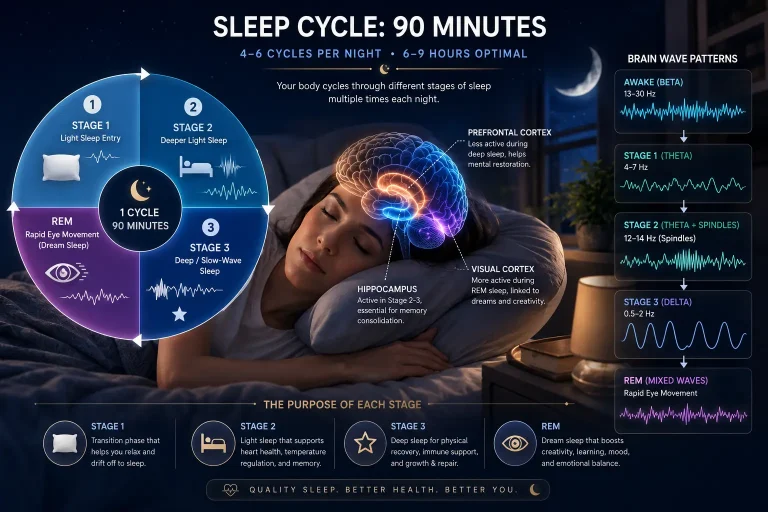
The willpower component adds another layer. Your prefrontal cortex—the part of your brain that handles decision-making and impulse control—is less active when you’re sleep-deprived. Your ability to say “no” to food weakens. You don’t have the mental resources to maintain your diet. This isn’t a motivation problem; it’s a neurological one.
Recovery, Muscle Growth, and Fat Loss
Here’s a reality many fitness enthusiasts miss: your body builds muscle during sleep, not during workouts.
When you train, you create micro-tears in muscle tissue. The actual growth happens during recovery—particularly during deep sleep, also called slow-wave sleep.
During deep sleep, your body releases growth hormone. This hormone is essential for:
- Repairing muscle tissue
- Increasing muscle protein synthesis
- Strengthening connective tissue
- Optimizing body composition
Get insufficient deep sleep, and this entire process stalls. You can train perfectly, eat perfectly, and your muscles simply won’t recover or grow the way they should.
Why does this matter for fat loss? Because muscle tissue is metabolically expensive. A pound of muscle burns roughly 6 calories per day at rest, while a pound of fat burns roughly 2 calories. When you build muscle while losing fat, you’re creating the metabolically advantageous body composition that supports long-term weight management.
Without adequate sleep, you’re losing this benefit. Worse—research shows that under sleep deprivation, your body actually sacrifices muscle to preserve fat stores. Your body thinks it’s in survival mode and protects energy reserves while cannibalizing metabolically expensive tissue.
Additionally, sleep plays a crucial role in mitochondrial biogenesis—creating new mitochondria in your cells. More mitochondria = more metabolic capacity. Without adequate sleep, you’re not creating this additional metabolic machinery.
Hormonal Balance and Weight Management
Sleep deprivation disrupts your entire hormonal ecosystem. Let me break down the key players:
Insulin Sensitivity: When you’re sleep-deprived, your cells become more insulin-resistant. This means the same amount of carbohydrates triggers a larger insulin response. Excess insulin promotes fat storage and suppresses fat burning. Even if you’re eating the same thing, your body processes it less favorably when you’re tired.
Cortisol Dysregulation: Your stress hormone cortisol should be high in the morning and gradually decline throughout the day. Sleep deprivation flattens this pattern, keeping cortisol elevated throughout the day. Chronically elevated cortisol increases abdominal fat storage and accelerates muscle breakdown.
Thyroid Function: Thyroid hormones regulate metabolic rate. Sleep deprivation reduces thyroid hormone production and increases reverse T3 (the inactive form of thyroid hormone), effectively slowing your metabolism.
Sex Hormones: Testosterone (in both men and women) and estrogen are significantly impacted by sleep. Insufficient sleep reduces testosterone production and alters estrogen metabolism, both detrimental to fat loss and muscle building.
The compounding effect of these hormonal disruptions is profound. You’re not just tired—you’re biochemically reconfigured to store fat, break down muscle, and feel hungry.
Step-by-Step: Your Sleep Optimization Protocol
Knowing sleep is important is one thing. Actually improving your sleep is another. Here’s what actually works:
1. Establish Your Sleep Duration Target
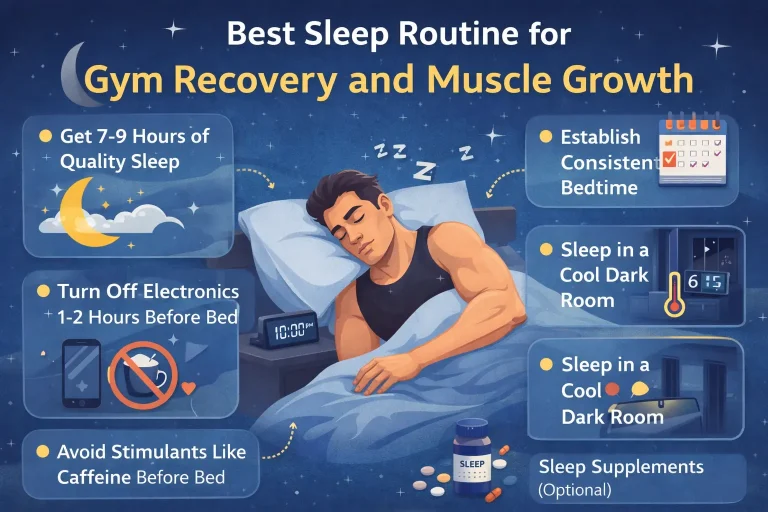
Most research points to 7-9 hours as optimal for body composition and athletic performance. But don’t treat this as gospel—the right amount varies.
Here’s how to find your target: Next week, go on vacation or take time off work. For one full week, sleep with no alarm—just wake naturally. Note your average sleep duration. That’s likely your natural sleep need. That’s your baseline.
Most people find this is 7.5-8.5 hours. If you’re training hard, you might need 8.5-9 hours. If you’re sedentary, you might get away with 7 hours.
The critical point: consistency matters more than perfection. Sleeping 7 hours every night is better than sleeping 5 hours on weekdays and 10 on weekends.
2. Lock In Your Sleep Schedule
Pick your target bedtime and wake time. Do this every single day—yes, including weekends.
Your body runs on circadian rhythms. Consistency is how you sync those rhythms. After about three weeks of consistent sleep times, your body will naturally get sleepy at bedtime and wake naturally at your target time.
This consistency dramatically improves sleep quality, which is often more important than duration.
3. Optimize Your Sleep Environment
This matters more than most people realize.
Temperature: Your bedroom should be cool—around 65-68°F (18-20°C). Your core body temperature needs to drop to initiate sleep. A cool room facilitates this. If you’re overheating at night, that’s destroying your sleep quality.
Darkness: Use blackout curtains. Even small amounts of light reduce melatonin production and fragment sleep. If light sensitivity is severe, consider a sleep mask.
Sound: White noise or earplugs can help. Sudden sounds during sleep fragments it, preventing you from reaching deep sleep stages.
Comfort: A good mattress and pillow aren’t luxuries—they’re tools. You spend 1/3 of your life on these things. Invest accordingly.
4. Create a Pre-Sleep Routine (30-60 minutes before bed)
Your pre-sleep routine signals to your body that sleep is coming.
- Stop work and stimulating activities 60 minutes before bed
- Dim lights or use blue-light-blocking glasses. Blue light suppresses melatonin, the hormone that initiates sleep.
- Avoid caffeine after 2 PM (it has a half-life of 5-6 hours; 2 PM intake means 50% is still in your system at 8-9 PM)
- Avoid heavy meals 3-4 hours before sleep (digestion interferes with sleep)
- Avoid alcohol close to bedtime. While it might help you fall asleep initially, it destroys sleep architecture and prevents deep, restorative sleep.
- Consider a warm bath or shower 90 minutes before bed. The subsequent drop in core temperature facilitates sleep onset.
5. Build a Nightly Ritual
This might include:
- Light stretching or yoga
- Journal writing (particularly for worry release)
- Meditation or breathing exercises
- Reading (physical books, not screens)
- Magnesium supplementation (consult healthcare provider first)
The ritual itself is less important than consistency and relaxation.
The Sleep-Exercise-Diet Trinity
Here’s something most people don’t consider: your sleep, diet, and exercise aren’t three separate efforts. They’re an integrated system where each component amplifies or diminishes the others.
When sleep is solid:
- Your diet adherence improves (less hunger, better impulse control)
- Your training performance increases (more energy, better recovery)
- Your body composition improves (muscle preservation, fat loss)
When sleep is poor:
- Your diet collapses (biological hunger, cravings)
- Your training suffers (low energy, poor recovery)
- Your body composition deteriorates (muscle loss, fat retention)
This is why you sometimes see people with imperfect diets and modest training who lose fat steadily (they have great sleep), while others follow pristine programs with minimal results (they’re sleep-deprived).
Think about timing too:
- Training timing: Training depletes your glycogen stores and creates the stimulus for adaptation. You need sleep that night to capitalize on that stimulus. A hard workout followed by inadequate sleep is largely wasted.
- Nutrition timing: Your body preferentially builds muscle when amino acids are available and you’re well-recovered. Timing protein around training is useful, but it’s meaningless without adequate sleep for muscle protein synthesis.
- Sleep timing: Try to sleep soon after training (within 3-4 hours if possible). This maximizes your anabolic window and growth hormone response.
Common Sleep Mistakes Sabotaging Your Results
Mistake #1: Inconsistent Sleep Schedule
You sleep seven hours during the week, then “sleep in” on weekends, getting 10 hours. This inconsistency is destroying your circadian rhythm adaptation. Your body never fully adjusts. Sleep quality remains suboptimal.
Fix: Same bedtime and wake time, every day. Yes, including weekends.
Mistake #2: Poor Sleep Environment
You’re sleeping in a bright room, with the TV on, at 72°F. You’ve created optimal conditions for fragmented, low-quality sleep.
Fix: Cool, dark, quiet environment. Invest in good bedding.
Mistake #3: Pre-Sleep Screen Time
You’re scrolling your phone until you get into bed. The blue light suppresses melatonin, and the stimulation keeps your mind engaged.
Fix: No screens 30-60 minutes before bed.
Mistake #4: Caffeine Timing
You grabbed coffee at 4 PM because you were tired. Now you can’t fall asleep until midnight. You’re fighting your own pharmacology.
Fix: No caffeine after 2 PM. Ever.
Mistake #5: Sleep Debt Accumulation
You chronically get 6 hours during the week, thinking you’ll “catch up” on weekends. You can’t catch up on sleep debt—it still damages your metabolism and hormones.
Fix: Consistently get adequate sleep. Treating sleep deprivation as normal is a choice that costs you results.
Mistake #6: Alcohol Before Bed
Alcohol makes you drowsy initially, so you fall asleep easily. But it fragments your sleep in the second half of the night, preventing deep sleep and REM sleep. You’re getting duration without quality.
Fix: No alcohol 3-4 hours before bed, or eliminate it entirely around training days.
Advanced Sleep Optimization for Serious Athletes
If you’ve nailed the basics and want to optimize further:
Sleep Tracking
Apps and wearables (Oura Ring, Apple Watch, Whoop) provide data on sleep duration and stages. Track for at least two weeks to establish your baseline. Look for patterns—which habits improve deep sleep? Which decrease it?
Data removes guesswork. If you think you’re sleeping well but your device shows fragmented sleep with minimal deep sleep stages, you now have concrete information to address.
Chronotype Optimization
You have a natural chronotype—you’re either naturally early-rising or late-sleeping. Rather than fighting this, align your training to your chronotype when possible.
Research shows morning exercisers often sleep better that night. Evening exercisers sometimes experience sleep disruption. But this varies individually. Your data will tell you what works for you.
Napping Strategy
A 20-minute power nap can improve alertness and performance. A 90-minute nap includes a full sleep cycle and provides genuine recovery. Longer naps risk grogginess.
For serious athletes on heavy training blocks, a strategic 20-30 minute nap on training days can improve performance and recovery.
Sleep Periodization
Just as you periodize training, you can periodize sleep. During heavy training blocks, prioritize 8.5-9 hours. During deload weeks, 7-7.5 is likely sufficient.
This mirrors your recovery needs and optimizes resource allocation.
FAQ Section
Q: How much sleep do I really need for weight loss?
A: Most people need 7-9 hours. Start with 8 hours consistently and assess your energy levels, performance, and recovery after two weeks. That’s your baseline. Individual needs vary based on age, training intensity, stress levels, and genetics.
Q: Does poor sleep really affect weight loss that much?
A: Yes. Studies show that people on identical calorie deficits lose significantly less fat when sleep-deprived compared to when well-rested. Poor sleep also shifts weight loss away from fat and toward muscle, which is the opposite of what you want.
Q: Can I make up for lost sleep on weekends?
A: Not really. Chronic sleep deprivation causes metabolic damage that a couple of long sleeps doesn’t repair. Consistency matters far more than occasional catch-up sleep.
Q: Does sleep affect my ability to build muscle?
A: Absolutely. Muscle protein synthesis, growth hormone release, and recovery all depend on sleep. Without adequate sleep, your muscles can’t adapt to training effectively, regardless of your diet and training program.
Q: What’s more important—sleep duration or sleep quality?
A: Both matter, but quality is more important than people think. Six hours of high-quality sleep beats eight hours of fragmented sleep. Work on both, but prioritize quality first.
Q: Should I exercise before or after I want to improve sleep?
A: Morning or afternoon training generally improves sleep. Intense training within 3 hours of bedtime can disrupt sleep in some people. Experiment with your timing and track results.
Q: Does sleeping more guarantee weight loss?
A: No. Sleep is necessary but not sufficient. You still need appropriate diet and exercise. Think of sleep as enabling the other two variables to work properly. Without sleep, diet and exercise are far less effective.
Q: What about sleep supplements?
A: Magnesium glycinate, L-theanine, and melatonin have research support for some people. However, they’re far less impactful than behavioral changes like consistency, environment optimization, and routine. Focus on fundamentals first. Supplements are secondary.
Q: How long until better sleep improves my body composition?
A: You’ll notice improved energy and performance within 2-3 weeks of consistent sleep. Body composition changes take 4-8 weeks to become apparent, as these reflect metabolic changes over time.
Q: Can sleep quality affect my appetite the next day?
A: Yes. One night of poor sleep increases hunger hormones significantly the next day. Multiple nights of poor sleep creates a state of elevated hunger that makes dieting substantially harder.
Q: Is napping bad for nighttime sleep?
A: A 20-30 minute nap is generally fine. Longer naps or napping late in the day can interfere with nighttime sleep. If you’re napping daily to recover from consistently poor nighttime sleep, fix the nighttime sleep instead.
Conclusion
Let’s be clear about what sleep actually is: it’s a performance tool, not a luxury.
Every successful athlete, coach, and person serious about body composition treats sleep with the same rigor they apply to training and nutrition. They do this because they understand what the research clearly shows—sleep determines whether your diet and exercise efforts will produce results or whether you’re simply spinning your wheels.
If you’ve been frustrated with plateaus despite consistent effort, if your energy doesn’t match your dedication, if your body composition stubbornly refuses to change, the answer might not be training harder or eating less. It might simply be sleeping more.
The practical next step is simple:
- Decide your target sleep duration (start with 8 hours)
- Pick consistent bedtimes and wake times
- Optimize your sleep environment (cool, dark, quiet)
- Build your pre-sleep routine (no screens, low light, relaxation)
- Stay consistent for three weeks and assess how you feel
The changes to your energy, performance, recovery, appetite control, and eventually, body composition, will likely surprise you.
Sleep isn’t something you do after you’ve earned success. Sleep is how you earn success. Every other effort you’re making depends on it.
gh-quality, uninterrupted sleep provides more recovery than eight hours of fragmented sleep. Prioritize quality, but aim for both.
9. KEY TAKEAWAYS
- Sleep directly controls metabolism: Poor sleep reduces basal metabolic rate, mitochondrial function, and thermic effect of food—collectively burning hundreds fewer calories daily.
- Sleep regulates hunger hormones: One night of poor sleep increases appetite hormones dramatically while reducing fullness signals, making dietary adherence significantly harder.
- Muscle growth happens during sleep: Training creates the stimulus; sleep provides the recovery where muscle adaptation actually occurs. Without adequate sleep, training results are severely diminished.
- Sleep deprivation shifts composition toward muscle loss: Sleep-deprived bodies preferentially sacrifice muscle while protecting fat stores, causing you to lose the wrong tissues.
- Hormonal balance depends on sleep: Insulin sensitivity, cortisol regulation, thyroid function, and sex hormone production all deteriorate with poor sleep.
- Consistency beats occasional long sleeps: Seven hours every night is superior to five hours weekdays and ten on weekends. Your body adapts to consistency.
- Environment matters more than most realize: A cool (65-68°F), dark, quiet room dramatically improves sleep quality without requiring supplements or behavioral changes.
- Pre-sleep routine is crucial: 30-60 minutes without screens, with dimmed lights and relaxation, allows melatonin production and mental disengagement.
- Sleep enables all other efforts: Diet adherence and training performance both depend on sleep quality. These three variables are integrated, not separate.
- Sleep is a performance tool, not a luxury: Treating sleep with the same priority as training and nutrition is what separates people who achieve results from those who plateau.