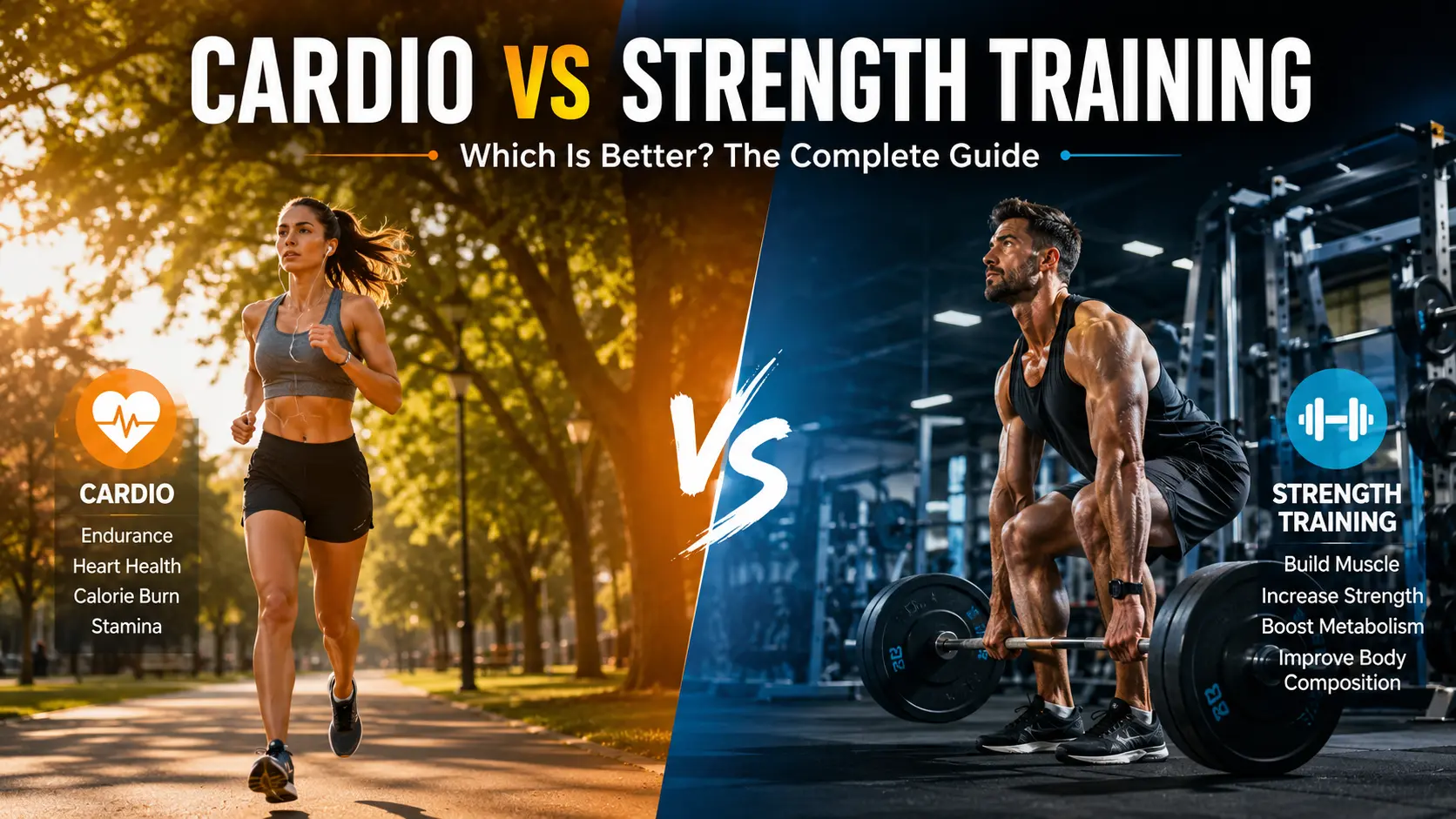
Cardio vs Strength Training: Which Is Better for Your Goals?
If you’ve ever scrolled through fitness social media or visited a gym, you’ve probably encountered the age-old debate: should you prioritize cardio or strength training? One expert swears by running marathons, another insists that nothing beats lifting weights. Your friend lost 30 pounds with cardio, while your colleague claims strength training transformed their body. So which is actually better?
Here’s the truth that nobody wants to hear: it’s not about choosing one or the other. But I know that’s not the simple answer you came looking for, so let’s dig deeper.
The real answer depends entirely on your specific goals, your current fitness level, your lifestyle constraints, and honestly, what you’ll actually stick with long-term. But before we get to your personalized answer, we need to understand what cardio and strength training actually do to your body—and how they’re fundamentally different.

Why This Debate Matters (And Why It’s More Nuanced Than You Think)
People get passionate about this topic because fitness is personal. It’s wrapped up in time investment, body image, health aspirations, and often, hard-won experience. Someone who lost significant weight through cardio naturally believes in cardio. Someone who gained confidence and strength through weight training becomes an advocate for that approach.
The problem isn’t that either side is wrong—it’s that they’re often answering different questions. Someone asking “how do I lose fat?” has different needs than someone asking “how do I build muscle?” And someone concerned with long-term health needs different guidance than an athlete preparing for competition.
The fitness industry hasn’t done us any favors by forcing a false choice between these two powerful training methods. The best approach for most people isn’t picking a side—it’s understanding what each method excels at, then strategically combining them.
Understanding Cardio: More Than Just Running
When people say “cardio,” they usually mean running. But cardio is far broader than that. Cardiovascular training is any sustained physical activity that elevates your heart rate and increases oxygen consumption. This includes:
Types of Cardio Training:
- Steady-state cardio: Running, cycling, swimming, or rowing at a consistent moderate pace (think 20-45 minutes)
- HIIT (High-Intensity Interval Training): Short bursts of maximum-effort activity alternated with recovery periods
- LISS (Low-Intensity Steady State): Longer, easier-paced activity like leisurely walking or easy cycling
- Sports and recreational activities: Basketball, tennis, hiking, dancing—anything that gets your heart rate up
How Cardio Works Physiologically:
Your cardiovascular system is an oxygen-delivery machine. When you do cardio, your heart, lungs, and blood vessels work together to deliver oxygen-rich blood to your muscles. Over time, this creates adaptations:
- Your heart becomes more efficient (lower resting heart rate)
- Your capillary density increases (better oxygen delivery to muscle tissue)
- Your mitochondria expand (the cellular powerhouses that generate energy)
- Your insulin sensitivity improves (cells become more responsive to insulin)
- Your VO2 max increases (the maximum oxygen your body can utilize)
These aren’t just fitness metrics—they’re directly linked to longevity, disease prevention, and daily energy levels.
Cardio’s Greatest Strengths:
- Calorie burning: A 155-pound person can burn 300-600+ calories in 45 minutes depending on intensity
- Accessibility: You can do it almost anywhere with minimal equipment
- Cardiovascular health: Directly strengthens your heart and improves aerobic capacity
- Mental health benefits: Proven stress reduction and mood enhancement
- Sustainability: Easier on joints than intense strength training for many people
- No equipment needed: You can start today without a gym membership
Understanding Strength Training: Building Beyond Muscles
Strength training—also called resistance training or weight training—involves working against resistance to build strength and muscle. This encompasses:
Types of Strength Training:
- Free weights: Dumbbells, barbells (the gold standard for building strength)
- Weight machines: Guided resistance that reduces skill requirements
- Bodyweight exercises: Push-ups, pull-ups, squats, and dips
- Resistance bands: Portable, joint-friendly progressive resistance
- Combination approaches: Many programs mix multiple modalities
How Strength Training Works Physiologically:
When you lift weights, you’re creating microscopic tears in muscle fibers. Your body repairs these tears, and in doing so, makes the muscle fiber slightly larger and stronger. This process involves:
- Hypertrophy (muscle growth): Increased protein synthesis builds bigger muscles
- Neurological adaptation: Your nervous system becomes more efficient at recruiting muscle fibers
- Hormonal changes: Increases in testosterone, growth hormone, and IGF-1 (all anabolic hormones)
- Metabolic elevation: Muscle tissue is metabolically active—more muscle means higher resting metabolic rate
- Bone density improvement: Resistance training is one of the best ways to build and maintain strong bones
- Improved insulin sensitivity: Similar to cardio, but through different mechanisms
Strength Training’s Greatest Strengths:
- Muscle building: The most effective way to gain and maintain muscle mass
- Metabolic boost: Increased muscle tissue raises your resting metabolic rate
- Bone health: Critical for aging adults, especially important for women
- Functional strength: Carries over to daily life (carrying groceries, playing with kids, etc.)
- Injury prevention: Strong muscles protect joints
- Appearance: Builds the lean, toned physique many people desire
- Efficiency: Can achieve significant results in 3-4 hours per week
Cardio vs Strength Training: The Direct Comparison
Now that we understand what each does, let’s compare them directly across the most important dimensions.
Fat Loss: Which Burns More?
This is the question that starts most of these debates. The simple answer: both work, but they work differently.
Cardio for fat loss:
- Burns calories during the activity itself
- A 45-minute run might burn 400-600 calories
- HIIT can elevate metabolism for hours afterward (the “afterburn effect” or EPOC—excess post-exercise oxygen consumption)
- Creates a direct caloric deficit that contributes to weight loss
Strength training for fat loss:
- Burns fewer calories during the activity (maybe 200-400 for a solid session)
- BUT increases resting metabolic rate over time
- Preserves muscle mass while losing fat (cardio alone can cause muscle loss)
- Builds the physique most people actually want (not just smaller—stronger and more defined)
Here’s what the research shows: they’re roughly equivalent for total fat loss when calories are controlled. A 2016 meta-analysis found that cardio and strength training produced similar weight loss results. However, strength training users ended up with more muscle mass, meaning they looked better at the same weight.
The real winner? They’re best used together. Cardio creates immediate caloric burn and cardiovascular benefits. Strength training preserves muscle and builds your metabolism. Combined, they’re more effective than either alone.
Muscle Building: Can Cardio Compete?
This is where the answer is clearer: strength training wins decisively.
Cardio doesn’t build significant muscle. Endurance athletes (marathon runners, cyclists) develop some muscle endurance adaptations, but they rarely develop the size and strength gains that resistance training produces.
If muscle building is your goal, strength training is non-negotiable. That said, moderate amounts of cardio won’t sabotage your gains if you eat enough protein and calories. It’s the excessive cardio (2+ hours daily) combined with insufficient calories and protein that undermines muscle building.
Time Efficiency: Doing More With Less
This matters because real people have real schedules.
Cardio’s time requirement:
- 45-60 minutes for meaningful calorie burn
- 20-30 minutes for HIIT workouts
- Needs to be done regularly (4-5 days per week for optimal results)
Strength training’s time requirement:
- 45-60 minutes for a complete workout
- 3 days per week can produce significant results
- Total weekly time commitment: 2.25-3 hours
If you have 5 hours per week for training, strength training (3 days) + cardio (2 days) is optimal. If you have 3 hours per week, strength training (3 days) is the smarter choice for body composition.
Sustainability and Enjoyment: The Hidden Factor
Here’s something many fitness articles overlook: the best workout is the one you’ll actually do consistently.
A marathon runner who hates the gym won’t stick with weight training. A competitive lifter who finds cardio boring won’t do 5 cardio sessions per week. Sustainability beats optimization every time.
The good news? You don’t have to choose if you don’t want to. Many people find that 3 days of strength training and 2 days of cardio (or 1-2 days of HIIT) is both effective and sustainable.
Injury Prevention: Which Is Safer?
Both can be risky if done poorly. But they risk different injuries.
Cardio injury risks: Repetitive stress injuries (runner’s knee, shin splints, IT band syndrome) from the pounding of running. These develop gradually from overuse.
Strength training injury risks: Acute injuries from poor form or too-heavy weight (strained muscles, joint strain). These often happen suddenly.
The verdict? Strength training is slightly safer for injury prevention long-term because it builds strong, resilient tissues. However, proper technique matters significantly, so beginners should consider coaching.
The Real Answer: It Depends On Your Goals
Let’s cut through the debate and get specific.
Goal #1: Weight Loss (Fat Loss)
If your primary goal is losing fat, here’s your ideal approach:
The strategy: Strength training 3-4 days per week, cardio 2-3 days per week, with nutrition being the primary lever (you can’t out-train a bad diet).
Why? Strength training preserves muscle while you’re losing fat, cardio burns calories directly, and the combination prevents metabolic adaptation (where your body adjusts to burn fewer calories).
Progression: Start with 2 days of strength training and 2-3 days of light cardio if you’re new to exercise. Once that’s comfortable, increase to 3 days of strength training.
A 155-pound person doing this might realistically lose 0.5-1 pound per week—which is sustainable and allows them to retain muscle and strength.
Goal #2: Muscle Building and Strength
If you want to build muscle and get stronger, this is clear-cut.
The strategy: Strength training 4-5 days per week (structured progressive programming), cardio 1-2 days per week maximum (light to moderate intensity).
Why? Building muscle requires progressive overload (gradually increasing weight/difficulty). It also requires adequate recovery. Too much cardio interferes with both—it burns calories you need for muscle growth and can compromise recovery.
What cardio to do: Light steady-state (walking, easy cycling) rather than intense HIIT. Think of cardio as a supplement for cardiovascular health, not the main focus.
A focused strength training program might yield 1-2 pounds of muscle per month for beginners, even without any cardio at all.
Goal #3: Overall Health and Longevity
If your goal is living longer, feeling better, and maintaining health—the most important goal, really—you need both.
The strategy: Strength training 3 days per week, cardio 3-5 days per week, with variety in cardio (mix steady-state with HIIT).
Why? This combination addresses cardiovascular health (cardio), metabolic health (both), bone density (strength), functional ability (strength), and mental health (both). Research on longevity consistently shows that people who do both types of exercise live longer than those who do only one type.
Goal #4: Athletic Performance
This depends on the sport, but generally:
The strategy: Sport-specific training + strength training for complementary fitness + light conditioning.
For example, a baseball player needs explosive strength (strength training), rotational power (sport-specific work), and cardiovascular base (light cardio). A soccer player needs strength (accident prevention), cardiovascular capacity (lots of cardio), and sport-specific skills.
Work with a coach to balance these appropriately.
The Science of Combining Both Methods: Smart Programming
If you’re convinced you need both (which most people should be), here’s how to structure it without burning out or spinning your wheels.
The Weekly Framework
For general fitness and fat loss:
- Monday: Strength training (lower body or full body)
- Tuesday: Cardio (moderate intensity, 30-45 minutes)
- Wednesday: Strength training (upper body or full body)
- Thursday: Light cardio (easy walk, yoga, or light cycling) OR rest day
- Friday: Strength training (full body or weak points)
- Saturday: Cardio (HIIT or moderate, 20-40 minutes)
- Sunday: Rest or very light activity
This balances stimulus, recovery, and sustainability.
For muscle building with some cardio:
- Monday-Wednesday-Friday: Strength training (full-body or upper-lower split)
- Tuesday-Thursday: Light cardio (20-30 minutes)
- Saturday: Optional: Light cardio or active recovery
- Sunday: Rest
This prioritizes strength training while maintaining cardiovascular health.
Periodization: Cycling Your Focus
Smart programming isn’t doing the same thing forever. It’s strategically shifting your focus every 8-12 weeks:
Hypertrophy phase (4-6 weeks): Emphasize strength training, reduce cardio to maintenance level. Focus on building muscle.
Strength phase (4-6 weeks): Emphasize heavy strength training, maintain cardio. Focus on building strength and maintaining muscle.
Conditioning phase (2-4 weeks): Maintain strength training at moderate level, emphasize HIIT cardio. Build work capacity and conditioning.
This prevents boredom, prevents plateaus, and keeps your body adapting.
Common Mistakes People Make (And How to Avoid Them)
Mistake #1: Choosing Based on Trends
You see an Instagram fitness influencer with an amazing physique who credits cardio, so you do endless cardio. A month later, nothing changes. Meanwhile, they probably do a lot of strength training too—but that doesn’t photograph as well as running at sunset.
The fix: Choose based on your actual goals, not someone else’s approach.
Mistake #2: Doing Too Much of One and Not Enough Recovery
This is surprisingly common. Someone decides they need cardio AND strength training, so they do intense workouts 6-7 days per week with minimal sleep. Their body breaks down instead of improving.
The fix: More isn’t always better. 5-6 hours of strategic training per week with adequate recovery beats 12 hours of haphazard training.
Mistake #3: Forgetting That Nutrition Is the Foundation
You can’t out-train a bad diet. Seriously. I’ll say it again: nutrition is roughly 70% of the body composition equation. Training is the 30%.
If you’re doing cardio and strength training but eating junk food and not enough protein, your results will disappoint you.
The fix: Prioritize adequate protein (0.7-1g per pound of bodyweight), eat mostly whole foods, and maintain an appropriate calorie level for your goal.
Mistake #4: Ignoring Recovery
Recovery is where the magic happens. Your muscles grow when you sleep. Your body adapts to training when you’re resting. If you’re shortchanging sleep (less than 7 hours), you’ll stall out regardless of how perfect your training is.
The fix: Aim for 7-9 hours of sleep. If you can’t do that, rethink your training volume.
Mistake #5: Not Tracking Progress
How do you know what’s working? You measure.
The fix: For strength training, track your lifts (weight used, reps completed). For cardio, track distance/time/heart rate. For overall fitness, track body composition, not just scale weight. Weigh yourself weekly (but don’t obsess over daily fluctuations).
Expert Tips for Maximum Results
Progressive Overload Is Everything
Whether it’s cardio or strength training, your body adapts to the demands you place on it. To keep improving, you must gradually increase those demands.
For strength training: Aim to add weight or reps every 1-2 weeks. If you’re doing 3 sets of 8 reps at 200 pounds, next week target 3 sets of 9 reps. The following week, maybe 3 sets of 10 reps. Then increase the weight.
For cardio: Run a bit longer, go a bit faster, or increase intensity. Track your metrics.
Fuel Your Training With Proper Nutrition
You can’t build muscle without adequate protein. You can’t lose fat without a calorie deficit. The macronutrient and calorie prescription depends on your goal:
For muscle building: Eat in a slight calorie surplus (200-300 above maintenance) with 0.8-1g protein per pound of bodyweight.
For fat loss: Eat in a calorie deficit (300-500 below maintenance) with at least 0.7-0.8g protein per pound of bodyweight.
For general health: Eat around maintenance calories with balanced macronutrients.
Recovery Optimization Goes Beyond Sleep
- Hydration: Drink half your body weight in ounces of water daily (minimum)
- Stress management: Stress hormone cortisol interferes with recovery. Manage stress through meditation, walks, or hobbies
- Movement quality: A 10-minute warm-up prevents injuries and improves performance
- Deload weeks: Every 4-6 weeks, reduce volume by 40-50% to let your body fully recover
Master the Mind-Muscle Connection
You can go through the motions without actually engaging the right muscles. This is especially important for strength training.
When doing any exercise, slow down slightly and really feel the muscle working. This produces better results than rushing through with momentum.
FAQ:
Q1: Can I do cardio and strength training on the same day? A: Yes, but sequence matters. Do strength training first when you’re fresh and can lift heavier. Cardio after. This ensures you’re not compromising your strength workout quality.
Q2: How much cardio is too much? A: More than 5-6 hours per week of intense cardio while trying to build muscle is counterproductive. For general health, 150-300 minutes per week of moderate cardio is ideal.
Q3: Will strength training make me bulky if I’m a woman? A: No. Women don’t produce enough testosterone to develop “bulky” muscles like men do. Strength training will build lean muscle, improve your metabolism, and give you the toned look most women want.
Q4: Is it ever too late to start strength training? A: Never. Research shows people in their 70s and 80s can build significant muscle and strength with progressive resistance training. It’s one of the best investments in your future health.
Q5: What’s the best cardio for fat loss? A: For fat loss, a mix of steady-state cardio (for calorie burn) and HIIT (for afterburn effect and time efficiency) works best. HIIT 1-2 times per week plus steady-state 1-2 times works well.
Q6: Can I build muscle while doing cardio? A: Yes, if you eat enough calories and protein and don’t do excessive cardio. Moderate cardio (2-3 hours per week) won’t significantly interfere with muscle building.
Q7: What’s the fastest way to lose weight? A: A calorie deficit with adequate protein and a mix of strength and cardio training. Expect 0.5-2 pounds per week depending on your deficit. Faster isn’t always better—steady and sustainable wins.
Q8: Should beginners do cardio or strength training first? A: Both. Beginners should start with strength training (learn proper form), add moderate cardio. Master the fundamentals before chasing extreme approaches.
Q9: How long does it take to see results? A: Strength gains appear first (2-3 weeks). Visible muscle changes take 4-6 weeks. Fat loss (with proper diet) shows in 2-3 weeks. Cardiovascular improvements (better endurance, lower resting heart rate) take 4-6 weeks.
Q10: Is it okay to do cardio on rest days? A: Light cardio (easy walk, light cycling) on rest days is fine and even beneficial. Intense cardio defeats the purpose of a rest day.
Conclusion: Your Personalized Path Forward
Here’s what we know:
Cardio and strength training aren’t competitors—they’re complementary tools in your fitness toolkit. Neither is “better” in an absolute sense. The answer depends entirely on what you’re trying to achieve.
If you want to lose fat and keep the muscle: Do both, with an emphasis on strength training.
If you want to build muscle: Prioritize strength training, add light cardio for health.
If you want long-term health and longevity: Do a balanced mix of both.
If you have limited time: Strength training 3x per week beats cardio-only.
The best program for you is the one you’ll actually do consistently. If you hate running, don’t force yourself to run. If you hate the gym, start with bodyweight and cardio. Your commitment to consistency matters far more than having the “perfect” program.
Start where you are. Use what you have. Do what you can. Then improve incrementally from there.
The fitness industry profits from confusion and fad solutions. The truth is simpler: a reasonable combination of resistance training and cardiovascular training, paired with basic nutrition principles and adequate recovery, produces results for nearly everyone.
You don’t need to choose a side in this debate. You need to choose your own path, and now you have the information to do it intelligently.