
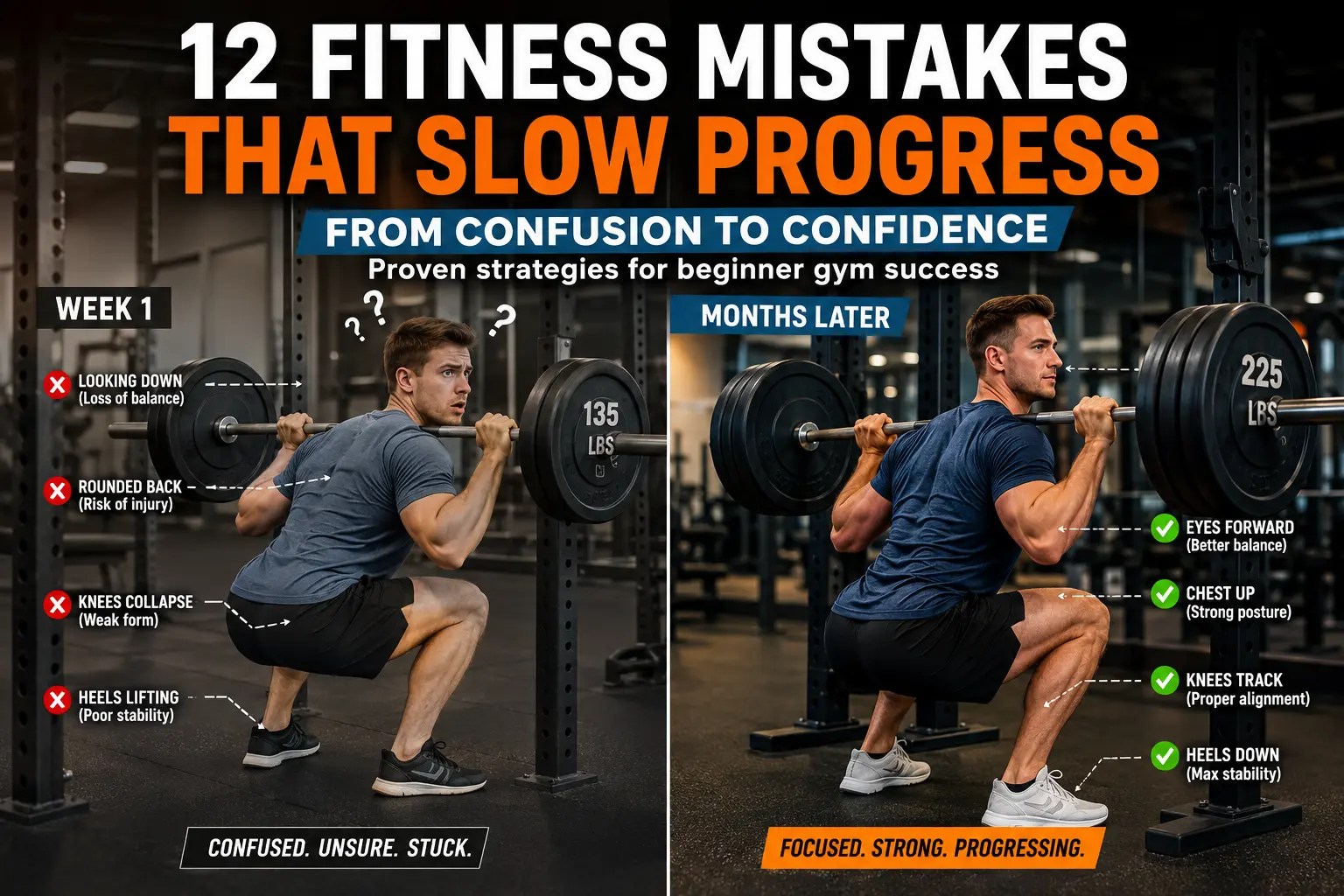
12 Common Fitness Mistakes That Slow Your Progress
You’ve been hitting the gym three, four, sometimes five days a week. You’re showing up, putting in the work, and honestly? You’re exhausted. But when you look in the mirror or step on the scale, the changes feel microscopic compared to the effort you’re pouring in.
Sound familiar?
Here’s what nobody tells you when you’re starting your fitness journey: the problem isn’t your dedication. It’s probably not even your work ethic. Instead, you’re likely making one—or several—of the same mistakes that slow down thousands of gym beginners every single year.
The frustrating part? These aren’t things you couldn’t have fixed. In fact, most of them are easier to correct than continuing on your current path. And once you understand what’s holding you back, progress becomes almost inevitable.
I’ve spent the last fifteen years helping people navigate the fitness world, and I’ve seen every variation of these mistakes imaginable. The good news is that the solutions are straightforward. By the time you finish reading this, you’ll know exactly what’s potentially limiting your results and, more importantly, how to fix it.
Let’s talk about the twelve most common fitness mistakes that are probably slowing your progress right now.
Why Beginners Hit Progress Walls
Before we dive into specific mistakes, it’s worth understanding why progress plateaus happen in the first place.
When you’re completely new to training, almost anything works. Your body is so responsive to stimulus that even imperfect training produces results. You show up, you lift things, and your body adapts. It’s magical, and it’s why those first few months feel so rewarding.
But here’s the thing: your body’s adaptation system is relentless and efficient. As you get stronger, your nervous system adapts to movements, your muscles adapt to loads, and your metabolic system adjusts to your activity level. What worked in month one doesn’t work as well in month four because your body has become more efficient at handling that stimulus.
This is where most people get stuck. They keep doing the same thing expecting different results, which is—well, you know the definition of insanity.
The mistakes we’re about to discuss are really just variations of this core issue. They’re all ways that people fail to give their bodies a reason to continue adapting and improving.

Mistake #1: Neglecting Progressive Overload
Let’s start with the most foundational fitness concept: progressive overload.
Progressive overload means gradually increasing the demands placed on your muscles during exercise. It’s literally the mechanism that drives all progress in strength training. Without it, your body has no reason to get stronger or more muscular.
Here’s what this typically looks like: you walk into the gym, perform the same exercises with the same weight for the same number of reps week after week. It feels safe. It feels controlled. And it’s precisely why you’re not progressing.
Your muscles adapt to demands. To continue adapting—to continue growing stronger or bigger—you must increase those demands. This could mean:
- Adding weight to the bar (the most straightforward approach)
- Increasing reps or sets
- Decreasing rest periods between sets
- Improving exercise range of motion
- Adding extra sessions to your weekly routine
The most common version of this mistake I see is what I call “weight wandering.” Someone has been deadlifting 225 pounds for six months. Six months! When you ask why they don’t increase the weight, the answer is usually “I’m comfortable with this weight” or “I don’t want to get hurt.”
The irony? Staying at the same weight is more likely to cause problems than progressively increasing load. Muscles that aren’t being challenged become prone to injury because they lose responsiveness and adaptability.
The Fix: Pick a number. Write it down. Aim to beat it each week. This could be one more rep, one more pound, or one less second in rest time. Just pick something you can measure and improve on consistently.
Mistake #2: Poor Form and Technique
A close second to progressive overload is exercise form. This one actually impacts both progress and safety, which makes it critical.
Bad form has multiple consequences. First, it reduces the effectiveness of the exercise—if you’re not moving through the correct range of motion or activating the right muscles, you’re wasting your time. Second, it significantly increases injury risk. Third, it makes progressive overload impossible because you can’t reliably repeat the same movement pattern.
Let me give you a specific example. I see countless people doing bent-over rows by essentially just pulling their elbows upward instead of pulling from their lats. The weight moves, sure, but the wrong muscles are doing the work. They get frustrated that their back isn’t growing, while completely ignoring the fact that they’re not actually training their back.
The same thing happens with leg press, bench press, squats, and virtually every other exercise. People develop accommodations and shortcuts that allow them to move heavier weight, but in doing so, they change which muscles do the actual work.
Why Form Gets Sloppy: Usually, it’s because someone increased the weight before mastering the movement pattern. When you’re struggling to control the weight, form naturally breaks down. Ego also plays a role—it’s more satisfying to load up a heavy barbell and grind out reps than to use less weight and move beautifully.
The Fix: Before adding significant load to any movement, spend time getting comfortable with it. Start lighter than feels necessary. Focus on feeling the right muscles working. Film yourself from multiple angles. Ask experienced lifters for feedback. Consider working with a qualified coach for at least a few sessions to establish proper movement patterns.
Mistake #3: Inadequate Recovery
This is where fitness theory and real-world behavior diverge dramatically.
Everyone intellectually understands that muscles grow during rest, not during training. Training creates the stimulus; recovery is when adaptation happens. Yet despite knowing this, most people prioritize training volume over recovery quality. They think recovery means sitting still, which sounds boring compared to lifting heavy things.
Recovery is actually much more complex—and much more controllable—than most people realize.
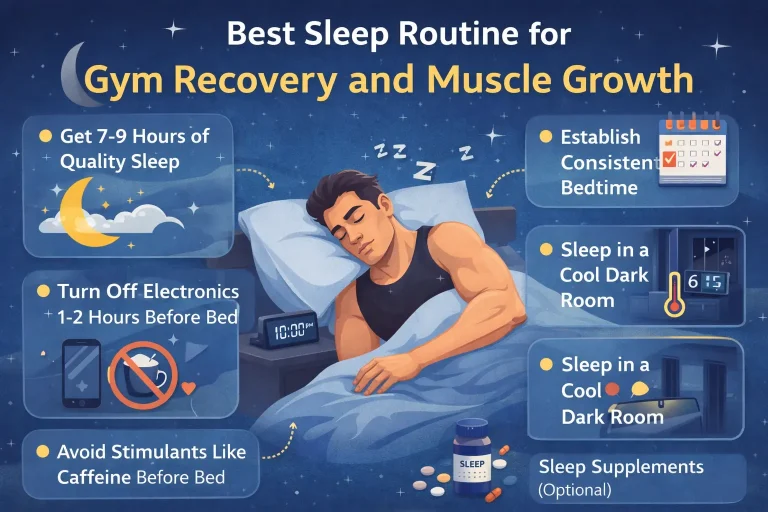
Sleep is the primary adaptation driver. When you sleep, your body releases growth hormone, consolidates neural adaptations, and repairs tissue damage from training. Someone training hard but sleeping five hours per night will always lose to someone training moderately but sleeping eight hours. This isn’t a minor factor; sleep quality probably accounts for thirty to fifty percent of your progress.
Active recovery matters too. This doesn’t mean another training session; it means movement that facilitates blood flow without creating new stimulus. A twenty-minute walk, some light stretching, or an easy bike ride on a non-training day can meaningfully improve your recovery.
Nutrition timing and composition impacts recovery. Your body needs adequate protein and calories to repair and build tissue. If you’re training hard but eating inadequately, you’re fighting against your own recovery.
Stress management is often overlooked but critical. Elevated cortisol from chronic stress interferes with recovery. If you’re training hard, sleeping poorly, eating inadequately, and stressed about work, your body is getting mixed signals.
The Fix: Treat recovery like a training session you don’t skip. Aim for eight hours of sleep consistently. Eat adequate protein (roughly 0.8–1 gram per pound of body weight). Take at least one full rest day per week. If you’re training hard more than four days per week, include at least one dedicated recovery day.
Mistake #4: Ignoring Nutrition
You can’t out-train a bad diet. You also can’t build muscle in a caloric deficit or lose fat in a caloric surplus. Nutrition isn’t just important—it’s literally the foundation that determines whether your training produces the results you want.
The confusion around nutrition in fitness is astounding. People oscillate between extreme approaches: they’re either counting every macro obsessively or ignoring nutrition completely. The truth is somewhere in the middle and far less complicated than the fitness industry makes it seem.
For muscle building, you need three things: adequate calories (roughly 300-500 above maintenance), sufficient protein (0.8-1g per pound of body weight), and consistent training. That’s it. Everything else is optimization. You don’t need expensive supplements, meal timing doesn’t matter as much as people claim, and carbs aren’t evil.
For fat loss, you need a caloric deficit (500-1000 calories below maintenance), adequate protein to preserve muscle, and consistent training. Again, the basic formula is straightforward.
The mistake most people make: They focus on the wrong aspects of nutrition. They worry about meal timing when they haven’t nailed total caloric intake. They obsess over whether carbs should come from rice or oats when they’re eating way too much total carbohydrate. They buy expensive supplements when they need to eat more vegetables.
The other mistake: They treat nutrition as something you do “on and off.” Nutrition isn’t something to be perfect at for three months then abandon. It’s a lifestyle variable. If you want consistent progress, you need consistent nutrition—not perfect, but consistent.
The Fix: Start simple. Track your current eating for three days to understand your baseline calorie and protein intake. Adjust to hit your targets. That’s genuinely all you need to do for the first six months.
Mistake #5: Lack of Structured Programming
This is where I see the most deviation between what works and what people actually do.
A structured program is simply a planned sequence of exercises, sets, reps, and progression designed to drive specific adaptations over time. It sounds complicated, but it’s actually the simplest part of fitness.
Here’s what usually happens instead: Someone walks into the gym with a vague idea (“I’ll work chest today”), bounces between exercises based on what equipment is free, performs a random number of sets based on how they feel, and leaves when they’re tired. This approach has multiple problems:
- No consistency in stimulus, so no predictable adaptation
- No progression system, so improvement is accidental
- No periodization, so overuse injuries develop
- No accountability, so easy to regress when motivation dips
People are attracted to this approach because it feels creative and spontaneous. It’s actually just inefficient.
The evidence is overwhelming: structured training beats unstructured training for every possible outcome metric. More strength gain, more muscle growth, fewer injuries, better fat loss. It’s not even close.
A good program doesn’t need to be complex. In fact, simpler is usually better. A beginner just needs:
- A selection of compound movements (squats, deadlifts, presses, rows)
- A clear weekly structure (which movements on which days)
- A progression scheme (how to increase difficulty)
- Estimated duration (three to six months before cycling)
That’s a functional program. It doesn’t need to be customized to your specific biomechanics or designed by a fancy algorithm.
The Fix: Find a tested program designed for beginners. Look for ones that emphasize compound movements, include progression built-in, and have been validated by communities of actual users. Run it for three months. Then assess and potentially progress to something more advanced.
Mistake #6: Excessive Cardio
This is controversial in some circles, but it shouldn’t be: excessive steady-state cardio interferes with strength training progress.
Here’s why: Cardio creates a metabolic demand for energy. If you do too much of it—especially combined with inadequate eating—your body will prioritize survival over muscle building. Your nervous system also recovers from stimulus, and high volumes of cardio compete with strength training for recovery resources.
This doesn’t mean cardio is bad. Moderate cardio has real benefits for cardiovascular health, work capacity, and mental health. The mistake is treating cardiovascular training the same as strength training—or worse, doing massive amounts of it while trying to build muscle.
The reality: Someone doing forty minutes of steady-state cardio daily while trying to build muscle is creating a recovery problem they can’t overcome with nutrition alone. Their body is literally being signaled to stay lean and efficient—the opposite of muscle building.
The sweet spot: For most strength-focused goals, ten to twenty minutes of moderate intensity cardio, two to four times per week, is optimal. It provides cardiovascular benefit without interfering with recovery. Higher intensity interval training (HIIT) can be done more efficiently in less time.
The Fix: If you’re training for strength or muscle, keep cardio supplementary and moderate. If you’re training for fat loss, moderate cardio combined with a caloric deficit works great. Don’t do excessive amounts of either thinking it’s the solution.
Mistake #7: Unrealistic Expectations Weight loss exercises
The timeline expectations people have about fitness progress would be funny if they weren’t so destructive.
I regularly hear: “I’ve been training for three months and I don’t look like that guy who’s been training for five years. What am I doing wrong?” The answer is usually “You’re not doing anything wrong; you’re just expecting the wrong timeline.”
Here’s the reality of progress:
- Noticeable strength changes: 4-6 weeks
- Noticeable body composition changes: 8-12 weeks
- Significant muscle gain: 1-2 years of consistent training
- Advanced physique: 5+ years of consistent training
These timelines assume good nutrition, proper programming, adequate recovery, and consistency. Adjust them longer if any of those factors are weak.
The other expectation problem is comparing yourself to people on social media. You’re probably comparing:
- Your behind-the-scenes to their highlight reel
- Your natural genetics to their potential pharmaceutical assistance
- Your one year to their five years
The psychological cost of unrealistic expectations is real. People get discouraged, they quit, and they never actually give themselves a chance to see results. Others push dangerously hard trying to accelerate a timeline that can’t be accelerated, leading to burnout or injury.
The Fix: Establish a reasonable timeframe for what you’re trying to accomplish. Celebrate small wins. Take progress photos and measurements—the scale doesn’t tell the whole story. Compare yourself to who you were three months ago, not to someone else’s five-year result.
Mistake #8: Inconsistent Training
This one is simple but bears repeating: consistency beats perfection every single time.
I’ve seen people with objectively mediocre programs who trained consistently for two years completely outpace people on “optimal” programs who trained sporadically.
Here’s why: Your body adapts to consistent stimulus. Missing workouts breaks that pattern. Coming back after a miss, your body is less adapted than it was before, so you regress slightly. You then need time to get back to where you were before you can progress beyond it.
The math on this gets brutal. Miss one week per month? You’re actually only training effectively three weeks per month. That’s a 25% efficiency loss that compounds over years.
The other consistency issue: People treat consistency as all-or-nothing. “If I miss one workout, my whole program is ruined, so I might as well take the month off.” This thinking costs more progress than the missed workout ever would.
The Fix: Identify the absolute minimum training frequency you can maintain indefinitely. For most people, this is three to four days per week. Commit to that minimum. On weeks where motivation or circumstances allow, do more. But protect that minimum at all costs.
Mistake #9: Leading with Isolation Exercises
There’s a hierarchy to exercise selection for beginners, and most people skip the top tier.
Compound movements—exercises that involve multiple joints and muscle groups—should be the foundation of any beginner program. Think squats, deadlifts, presses, rows, pull-ups.
Why? Because:
- They drive the most overall progress
- They’re most efficient with time
- They improve athleticism and movement quality
- They build functional strength
- They’re easier to progressively overload
Isolation exercises are excellent supplementary work, but they shouldn’t be primary, especially when you’re new to training.
The mistake: Someone goes to the gym, spends thirty minutes doing bicep curls and tricep extensions, does a little cable work, and maybe some light chest press. They skip compound movements because they’re intimidating or require better form or feel uncomfortable.
This approach produces worse results than reversing it: spending the bulk of time on compounds and finishing with some light isolation work.
The Fix: Structure your workouts around compound movements. Dedicate 60-75% of your effort there. Use isolation exercises to address weak points or for variety. Learn to squat, deadlift, press, and row before worrying about isolation exercises.
Mistake #10: Not Tracking Progress
You can’t manage what you don’t measure.
People make amazing progress for a few weeks, then somewhere around week four or five they stop increasing weight or reps because they honestly don’t remember what they did last week. They think they’re progressing, but they’re actually just maintaining.
Tracking doesn’t need to be complicated. A simple spreadsheet where you record:
- Exercise name
- Weight used
- Reps performed
- Date
…is sufficient. You don’t need fancy apps or detailed logs unless you want them.
Why tracking works: It creates accountability. It provides clear evidence of progress when motivation is low. It removes ambiguity from decision-making about when to increase weight. Most importantly, it ensures that progression is intentional rather than accidental.
The Fix: Pick a tracking method you’ll actually use. Spreadsheet, phone app, piece of paper—it doesn’t matter. Just write down your working weights and reps. Review it before each session.
Mistake #11: Ignoring Individual Differences
This is subtle but important: people respond differently to training variables.
Some people make amazing progress with higher frequency training (five to six days per week). Others do better with lower frequency (three days). Some respond better to higher rep ranges, others to lower rep ranges. Some people need more volume, others less.
These differences exist and they’re not small variations—they can sometimes be quite dramatic.
The mistake is taking someone else’s program that worked perfectly for them and expecting it to work identically for you. Or worse, assuming that because a program isn’t working, you’re doing something wrong when you might just need a different approach.
The Fix: Follow a solid foundational program for 8-12 weeks. Track how you respond. If you’re making consistent progress with good form, keep going. If you’re stalling, try adjusting one variable at a time: add volume, change rep ranges, adjust frequency. Most good programs have built-in flexibility for these adjustments.
Mistake #12: Chasing Trends Over Timeless Principles
The fitness industry is relentless in creating new trends. New workout styles, new diet approaches, new supplements. It’s exhausting and most of it misses the point.
The fundamentals of progress haven’t changed in decades:
- Lift heavy things (progressive overload)
- Use proper form
- Eat appropriately for your goal
- Sleep enough
- Stay consistent
- Be patient
Any new program worth following includes these elements. Any trend that violates them probably isn’t worth your time.
The mistake: Chasing novelty instead of mastering basics. Constantly switching programs every few weeks looking for the magical one. Believing that the newest exercise or the newest supplement is finally the missing piece.
The Fix: Learn the fundamentals. Find a program rooted in proven principles. Run it consistently. Only change programs when you’ve genuinely plateaued, not just when something new catches your attention.
Expert Tips to Accelerate Your Progress
Beyond avoiding mistakes, here are some specific strategies to accelerate results:
1. Start with lower frequency and high consistency. Three days per week that you never miss beats five days per week that you miss regularly. Build the habit first.
2. Film your sets regularly. You can’t correct what you can’t see. Filming helps you identify form issues and track movement quality over time.
3. Embrace antagonistic training. Training a muscle and then its antagonist (like bench and rows) on the same day improves balance and recovery.
4. Use autoregulation. Instead of fixed rep ranges, use RPE (Rate of Perceived Exertion) to adjust difficulty based on how you actually feel that day. This prevents overtraining while maintaining progression.
5. Prioritize compound movements in your workout. Do them when you’re fresh and most alert, not at the end when you’re fatigued.
6. Invest in coaching early. A qualified coach for 4-6 sessions to establish proper form in main lifts is some of the best money you can spend.
7. Find your minimum effective dose. The least amount of training that produces results is usually more sustainable and creates better recovery capacity.
Common Mistakes to Avoid When Fixing These Mistakes
Interestingly, people often make mistakes while trying to fix their mistakes.
Mistake #1: Changing too many things at once. You go from doing seven different exercises randomly to following a structured program with six different exercises, improving your diet, getting eight hours of sleep, and adding cardio. Now you have no idea which change created the result or what to adjust if progress stalls.
Mistake #2: All-or-nothing thinking. “I messed up my diet on Tuesday so the whole week is ruined.” This thinking causes people to abandon progress they’ve made.
Mistake #3: Comparing your current self to idealized versions of others. This kills motivation faster than anything else.
Mistake #4: Waiting for the perfect moment to start. “Next Monday I’ll start this new program.” Meanwhile, three weeks pass and you’ve done nothing.
The Fix: Start immediately with the most impactful single change. Usually, this is implementing a structured program. Once that’s habit, add another change. Change one variable at a time.
Frequently Asked Questions
Q: How long does it take to see results from the gym?
A: You’ll feel stronger within 2-3 weeks and notice physical changes in 6-8 weeks. Visual muscle growth typically takes 12+ weeks. The timeline depends on your starting point, consistency, nutrition, and programming quality.
Q: Should I lift until failure every set?
A: No. Train until you have 1-3 reps left in the tank (RPE 7-8) on most sets. Lifting to failure is useful occasionally, but doing it constantly increases injury risk and hurts recovery. Train hard, not recklessly.
Q: Is muscle soreness (DOMS) a sign of a good workout?
A: Not necessarily. DOMS is just an indicator that something is new to your muscles. You can get great results without soreness, and you can be sore without getting good results. Focus on progressive overload, not soreness.
Q: How important is meal timing?
A: Less important than total daily intake. Eating your protein and calories around your training window is convenient, but it’s not critical. Total protein intake throughout the day matters far more than timing.
Q: Can I build muscle and lose fat simultaneously?
A: Beginners can do this (called “body recomposition”). Advanced lifters usually need to choose. Focus on building muscle with adequate calories, or lose fat with a deficit. Switching back and forth frequently produces mediocre results either direction.
Q: How many exercises should I do per muscle group?
A: For beginners, 2-3 compound exercises per muscle group weekly is usually sufficient. You can add 2-3 isolation exercises as supplementary work. More isn’t automatically better.
Q: Is it better to do full-body workouts or body-part splits?
A: For beginners, full-body or upper/lower splits usually work better than body-part splits. You train each muscle group 2-3 times per week, which is optimal for progress. Body-part splits work fine once you’re more advanced.
Q: Do I need supplements to see results?
A: Protein powder is useful for convenience, but not necessary. Everything else (creatine monohydrate aside) is optional. Focus on training, nutrition, and sleep first. Supplements are exactly that—supplementary.
Q: Why am I gaining weight even though I’m tracking calories?
A: Your calorie estimates might be off. Tracking errors are common. Other factors: increased water retention from new training stimulus, increased food volume (water weight), or actual under-counting of intake. Track for two weeks, then assess and adjust.
Q: How do I know if my program is actually working?
A: You’re getting stronger (increasing weight or reps), feeling better in your workouts, and seeing body composition changes. The scale isn’t a great measure initially because muscle and fat have different densities. Take photos and measurements.
Key Takeaways
The path to fitness progress is simpler than the industry wants you to believe:
- Progressive overload is non-negotiable. Gradually increase demands on your muscles.
- Form matters. Proper technique ensures results and prevents injury. Learn before loading.
- Recovery is training. Sleep, nutrition, and rest days are where adaptation happens.
- Nutrition supports training. You can’t out-train bad nutrition. Dial in basics first.
- Structure beats randomness. A simple program is infinitely better than random workouts.
- Consistency over perfection. Three great weeks beat one perfect week and three missed weeks.
- Compound movements are foundational. Build your training around squats, deadlifts, presses, and rows.
- Track your work. Measurement enables progression and removes guesswork.
- Respect individual differences. Your body might respond differently than others. Adjust accordingly.
- Master basics before chasing trends. Progressive overload, proper form, adequate nutrition, and consistency work. Everything else is optimization.
- Give it time. Three months is where visible changes start. One year is where people start seeing impressive results.
- Enjoy the process. People who love training consistently get better results than people who hate their program. Find training you actually enjoy.

![4 Ways to Lose Belly Fat: A Realistic 30-Day Formula for [Men & Women]](https://sleepingtime.online/wp-content/uploads/2025/12/lose-belly-fat-768x382.png)