

BMI Calculator: How Body Mass Index Works, Health Insights, and Real Limitations
If you’ve visited a doctor’s office or filled out a health form, you’ve likely seen the term BMI—Body Mass Index. BMI compares your weight to height to estimate body fat. This widely used health screening tool appears on medical charts and fitness apps everywhere. But what is a BMI calculator, how does it work, and should you rely on it to gauge your health?
Let’s delve into the world of BMI calculators, examining not only the mathematics behind the metric but also its history, practical applications, limitations, and what alternatives might offer a more comprehensive view of your health.

What Is BMI?
The Body Mass Index (BMI) is essentially a medical screening tool that measures the ratio of your height to your weight to estimate the amount of body fat you have. It’s a number that healthcare providers use to categorize individuals into weight classifications—underweight, normal weight, overweight, or obese—and to assess potential health risks associated with these categories.
BMI is popular because it is a simple measurement. Unlike complex assessments that need special equipment or training, BMI just needs your weight and height. This simplicity makes it popular for research and medical screenings.
How to Calculate Your BMI
The BMI formula is straightforward, although it differs slightly depending on whether metric or imperial measurements are used.
For metric measurements, the formula is:
BMI = weight (kg) / height (m)²
For example, if you weigh 70 kilograms and are 1.75 meters tall, you would calculate: 70 ÷ (1.75 × 1.75) = 70 ÷ 3.06 = 22.9.
For imperial measurements, the formula includes a conversion factor:
BMI = (weight in pounds / height in inches²) × 703
So if you weigh 160 pounds and are 66 inches tall (5 feet 6 inches), your calculation would be: (160 ÷ 4,356) × 703 = 25.8.
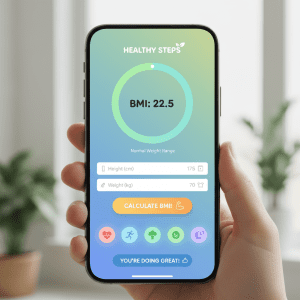
Most people today don’t need to do the math by hand, though. Numerous online BMI calculators and smartphone apps can instantly calculate your BMI by entering your height and weight. Your doctor’s office almost certainly has BMI calculations built into its electronic medical record system.
Understanding Your BMI Results
Once you’ve calculated your BMI, the next step is interpreting what that number means. For adults over 20, the standard weight classifications are:
- Underweight: BMI below 18.5
- Normal weight: BMI between 18.5 and 24.9
- Overweight: BMI between 25.0 and 29.9
- Obese Class I: BMI between 30.0 and 34.9
- Obese Class II: BMI between 35.0 and 39.9
- Obese Class III: BMI of 40.0 or higher
These categories are not arbitrary. Decades of research have found links between BMI and health. BMIs outside the ‘normal’ range are tied to a higher risk for conditions like diabetes, heart disease, hypertension, and some cancers.
For instance, a BMI that falls into the overweight or obese categories is linked to an increased risk of developing type 2 diabetes and cardiovascular problems. On the flip side, a BMI in the underweight category can indicate malnutrition or other underlying health issues.
The Fascinating History of BMI
Here’s something that might surprise you: the BMI formula wasn’t created by doctors or developed specifically for medical purposes. Its origins date back to 1832, when the Belgian statistician, mathematician, and astronomer Adolphe Quetelet developed what he called the Quetelet Index.
Quetelet focused on statistical analysis and the concept of the average person in population studies. His interest lay in quantifying characteristics of the ‘normal man’ for social physics, not in evaluating individual health. His research sample primarily consisted of high-income, predominantly white men from the Netherlands—an important detail to consider when evaluating the later limitations of BMI.
The formula languished in relative obscurity until the 1950s, when Louis I. Dublin, a statistician and vice president of Metropolitan Life Insurance Company, created weight tables for insurance clients after the company noticed an increase in claims from obese policyholders. Then, in 1972, physiologist Ancel Keys officially coined the modern term “body mass index” and provided evidence to support its usage through a study of 7,426 men. Keys emphasized BMI’s convenience for population-level studies, and it quickly gained traction in the medical community.
By 1997, the World Health Organization recognized obesity as a global epidemic. At this point, BMI had become the standard metric. Now, it appears on nearly all electronic medical records and is widely known among adults and children in developed countries.
The Real Limitations of BMI
While BMI is widely used and can be a helpful screening tool, it’s far from perfect. Understanding its limitations is crucial for accurately interpreting your results.
BMI Can’t Distinguish Between Fat and Muscle
BMI’s biggest flaw is that it measures excess body weight, not excess body fat. Muscle weighs as much as fat but is denser and takes up less space. Because of this, BMI can mislead people with higher muscle mass.
Athletes, bodybuilders, and people who engage in regular strength training often have BMIs that classify them as overweight or even obese, despite having low body fat percentages and excellent health. For these individuals, their “high” BMI is actually a reflection of muscle mass, not excess fat.
Age and Gender Differences
BMI does not account for differences in body composition due to age or gender. Older adults have more body fat than younger adults with the same BMI. Women have more body fat than men with equivalent BMI levels.
As we age, we naturally lose muscle mass—a condition known as sarcopenia. This means an older person might have a “normal” BMI while actually carrying significant amounts of body fat and very little muscle, which isn’t ideal for health. Conversely, a younger, muscular person with the same BMI would be in much better shape.
Ethnic and Racial Differences
Body composition and fat distribution vary by ethnicity, but BMI uses the same cutoffs for all individuals. Studies show Asian populations have more body fat at a given BMI than those of European descent. For them, health risks like diabetes and heart disease start at a BMI as low as 23, though this is in the ‘normal’ range by standard definitions.
Some populations have the same health risks at higher BMI levels than the standard cutoffs suggest. Using a single set of standards may lead to misclassification or missed opportunities for early intervention or create unnecessary worry and concern.
Height Matters
BMI isn’t completely independent of height. The formula tends to overestimate obesity among shorter individuals (those under 150 cm or approximately 5 feet) and underestimate it among taller individuals (those over 190 cm or approximately 6 feet 3 inches). This means BMI is less reliable as a health indicator for people at the extremes of height.
Special Populations
BMI is particularly unreliable for certain groups:
- Pregnant individuals: Pregnancy involves weight gain and various bodily changes. This makes BMI unsuitable during pregnancy.
- People with disabilities: Those who cannot walk may lose muscle, causing a lower BMI that does not match their health.
- People with eating disorders: BMI alone cannot capture the complexity of disorders like anorexia nervosa.
- Children and adolescents: Young people undergo growth and hormonal changes that affect their body composition, so different assessment methods are necessary.
BMI Is Still Useful—When Used Correctly
Despite these limits, BMI should not be dismissed. It is fairly accurate for around 90-95% of people and works well as part of a broader health check.
The key phrase here is “as part of”. BMI shouldn’t be the only metric used to assess someone’s health, but it can be a useful starting point for conversations about weight and health risks. When combined with other measurements and health indicators, BMI provides valuable context.
Think of BMI as a screening tool rather than a diagnostic one. It’s meant to identify individuals who might benefit from further assessment, not to definitively categorize someone’s health status. Your healthcare provider should consider your BMI alongside factors such as waist circumference, blood pressure, cholesterol levels, blood sugar levels, family history, and lifestyle habits to get a comprehensive picture.
Better Alternatives and Complementary Measures
Given the limitations of BMI, researchers and healthcare providers have developed alternative and complementary methods for assessing body composition and health risks.
Waist Circumference
Measuring your waist circumference is a simple way to assess abdominal fat, which is particularly concerning for health. Visceral fat—the fat stored around your organs—is a significant predictor of type 2 diabetes, heart disease, and stroke. You can measure your waist at the midpoint between the bottom of your ribs and the top of your hips. Generally, health risks increase when waist circumference exceeds 40 inches (102 cm) for men and 35 inches (88 cm) for women.
Waist-to-Hip Ratio
The waist-to-hip ratio (WHR) provides insight into your body shape and fat distribution. An “apple” shape, with more fat around the belly, carries higher health risks than a “pear” shape, with more fat around the hips and buttocks. To calculate your WHR, divide your waist measurement by your hip measurement. Ratios above 0.90 for men and 0.85 for women indicate higher health risks.
Body Roundness Index
The Body Roundness Index (BRI) is a newer metric that assesses the roundness or circularity of your body by measuring waist circumference in relation to height. Studies have shown that individuals with BRI scores of 6.9 or higher (on a scale of 1 to 15) had a 50% greater mortality risk than those with scores between 4.5 and 5.5. While more complex to calculate than BMI, online calculators make it accessible.
Body Fat Percentage Measurements
Direct measurements of body fat percentage provide more accurate information than BMI. Methods include:
- Bioelectrical impedance scales: These devices send a small electrical current through your body to estimate body fat based on the resistance it encounters. They’re affordable and convenient, though factors like hydration can affect accuracy.
- Skinfold calipers: A trained professional measures the thickness of skinfolds at specific body sites to estimate overall body fat. While technique-dependent, this method is relatively simple and affordable.
- DEXA scans: Dual-Energy X-ray Absorptiometry provides highly accurate measurements of body fat, muscle mass, and bone density. However, these scans are expensive and typically only available in clinical settings.
- Hydrostatic weighing: This “gold standard” method measures body density by weighing you underwater. It’s very accurate but requires specialized equipment and trained professionals.
A Holistic Approach to Health
Perhaps the most important takeaway is that no single number—whether it’s BMI, body fat percentage, or weight—tells the complete story of your health.
The Health at Every Size (HAES) philosophy offers a refreshing perspective, promoting the idea that health is not solely determined by weight. Instead of obsessing over numbers on a scale or a BMI chart, HAES encourages acceptance of body diversity and the adoption of health-promoting behaviors regardless of size.
Research increasingly suggests that there is no precise, universal link between weight and health outcomes. Health is influenced by a complex mix of behaviors, genetic factors, lean mass, fitness levels, and environmental risks. Two people with the same BMI can have vastly different health profiles.
Focusing on healthy behaviors—such as regular physical activity, balanced nutrition, adequate sleep, stress management, and social connections—tends to be more beneficial than fixating on achieving a specific BMI or weight. These behaviors improve health outcomes at any size, without the potential harm associated with weight stigma.
Using BMI Calculators Wisely
If you do use a BMI calculator, here are some practical tips for interpreting the results wisely:
Consider the context: Remember that BMI is just one piece of data. Factor in your age, gender, ethnicity, activity level, and medical history.
Don’t panic over a number: If your BMI falls outside the “normal” range, it doesn’t automatically mean you’re unhealthy. Discuss with your healthcare provider what the number means in the context of your overall health.
Look at trends, not snapshots: BMI can be useful for tracking changes over time. If you’re working on improving your health through diet and exercise, monitoring your BMI alongside other metrics can help you track your progress.
Combine with other measurements: Use BMI in conjunction with waist circumference, blood pressure, cholesterol levels, and other health markers to obtain a comprehensive picture.
Focus on health, not just weight: Rather than aiming for a specific BMI, focus on adopting sustainable, healthy habits that make you feel good and reduce your risk of disease.
The Bottom Line
The BMI calculator is a simple, accessible tool that has earned its place in healthcare as a quick screening method for potential weight-related health risks. Its convenience and ease of use make it practical for both clinical settings and personal health monitoring.
However, BMI is far from perfect. It was never intended to be a comprehensive health assessment, and it should certainly not be the sole determinant of your health status or self-worth. The metric’s inability to distinguish between fat and muscle, its lack of consideration for age, gender, and ethnicity, and its Victorian-era origins, which were based on a non-diverse population, all point to the need for more nuanced approaches.
The best approach is to view BMI as one tool in a larger health assessment toolkit. Use it alongside other measurements and, most importantly, alongside an honest conversation with a healthcare provider who knows your individual history and circumstances. Remember that health comes in many shapes and sizes, and the number on a BMI calculator doesn’t define your worth or your potential for a long, healthy life.
Whether your BMI falls within the “normal” range or not, prioritizing nutritious eating, regular physical activity, quality sleep, stress management, and positive relationships will serve your health far better than obsessing over any single metric. After all, health is about how you feel, function, and thrive—not just a number on a chart.
